cahwyguy: (Default)
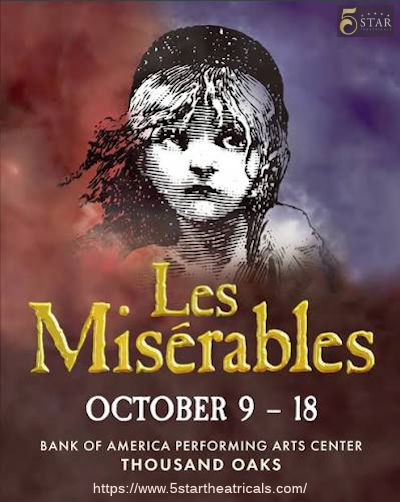
Les Miserables (5-Star)One of the things I love to do is see shows that's I've only seen in Broadway-level tours remounted in significantly different contexts. Whether it is a mid-size professional theatre like the Pasadena Playhouse; a large regional semi-Professional theatre ("semi" = mix of AEA and non-AEA actors) such as 5-Star, MTW, or La Mirada; a regional Community theatre such as Canyon Theatre Guide or Simi Rep; or an intimate (under 99 seat) theatre such as Chromolume, Group Rep, or Olive Branch — it is fascinating to see how these companies adapt the material and make it work on their different stages. Sometimes in works well. Sometimes it doesn't. But it is always interesting how time and budget forces more creativity.

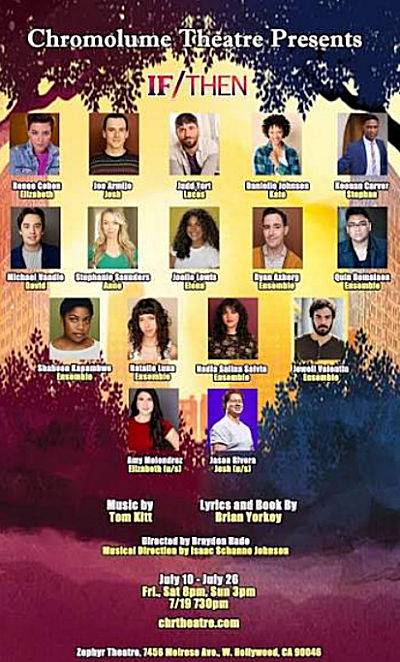
We saw that last week, when Olive Branch Theatricals mounted Come From Away. We saw it in the Colony Theatre production of Catch Me If You Can. We certainly saw it in the Chromolume production of "The Color Purpose" in an 80-something seat black box. We saw it again last night when 5-Star theatricals attempted an ambitious mounting of Les Misérables, in what I think is the largest production in their history (certainly since we started attending their shows way back in 2000. We walked out of the theatre together saying that they nailed it. 5-Star had an excellent production, with exceptional singing, a wonderful staging, and great performances. About the only technical issue I had was my usual one about visible tattoos, although in this case it appears the actress (the one playing Fantene) did attempt to cover them us; it's just that the makeup only faded them under the lights. But that is truly a minor minor complaint.

The last time we saw Les Misérables on stage was back in 2019, when the Broadway touring company was at the Pantages. The time before that was in 2011 at the Ahmanson, when I wrote:
Back in 1985, a musical juggernaut was created: Les Misérables, the musical version of the Victor Hugo novel. It hit Los Angeles in 1988, opening at a rejuivenated Shubert Theatre in Century City, where it ran for fourteen months. It returned to Los Angeles numerous times since then under Broadway/LA’s banner (2004, 2006). However, it wasn’t until the current 25th anniversary production at the Ahmanson Theatre that I finally saw the show. As my wife said as it ended last night, “Wow!”.

“Les Misérables” (the musical) tells the story of Jean Valjean, also known as prisoner 24601, and his adopted daughter, Cosette. It is based on the Victor Hugo of the same name, but does cut a few elements of the story. The story, which covers 17 years, is so complicated that a synopsis needed to be published in the program (seemingly, a bad sign). Given that, I’m not going to attempt to repeat it here. You can read it yourself in the Wikipedia Page on the show. Suffice it to say that the show condenses the 1,200 page, five volume novel into two acts of 90 minutes and 65 minutes respectively. The first act covers Jean Valjean’s release from prison and the interaction with the Bishop at Digne, the mayoral years at Montreiil-Sur-Mer where Valjean meets Fantine and takes responsibility for Cosette, the visit to Montfermeil where Valjean obtains Cosette from the Thénardiers, and the years in Paris where the student revolt begins and Marius and Cosette fall in love… all of this while the police officer Javert is chasing Valjean. The second act is solely in Paris and covers the student revolt, its failure, the subsequent growth of the relationship between Marius and Cosette, the final confrontations of Valjean and Javert, and the final redemption of Valjean. That’s a lot of material to cover—trying to cover so much material and so much time is the reason many great novels, such as Gone With The Wind, never make it to the Broadway stage. It is a testament to the original authors Claude-Michel Schönberg (music) and Alain Boublil (a French-language libretto) that they were able to take the beast of a novel and turn it into something understandable (although, arguably, this is really a full opera presented in the guise of a “musical”—at times, the lines between the two blurs). It is also a testament to the English language adapters, Herbert Kretzmer who developed the English language libretto, and Cameron Mackintosh, the original producer, who discovered the French production in 1982 and has sheparded it ever since (I’ll note Mackintosh’s full bio in the program was: “Produces musicals.”). The production was adapted by Sir Trevor Nunn and John Caird.

The translation does have its weak parts, however, primarily in how manipulative it is for the audience. By this, I mean the show in engineered to be a pleaser, with music that builds and leaves the toes tapping; with moments designed to permit the actors to shine; and with act-ending finales designed to stir the soul. In that sense, it is truly operatic as opposed to dramatic. It it also, at times, emotionally overwrought—again, a hallmark of the more operatic side. To some that is a fatal flaw that reduces the worth of the show, but I do enjoy the general effect.

Sadly to say, that production in 2019 at the Pantages was decidedly mixed: "The performances were soaring, and the direction and choreography made the best use of what they had to work with. Voices were remarkable, and the audience was excited. But production decisions mad the ultimate effort hard to embrace. At the Ahmanson, the tour was designed to use the entire stage, which is needed for the company to express the broadness and scope of the production. At the Pantages, the set artificially constrained the stage space, cutting the width of the Pantages stage by an estimated one-sixth on each side (that’s a one-third cut overall, for those math challenged). This limited movement, and obscured sight lines from the side. Further, the lighting was dark dark dark, and then smoke and fog effects were added. This made it hard to see. I recall that the Ahmanson staging was better lit and you could see the actors from a distance. The constrained stage and the lighting served to tone down the show."

5-Star, on the other hand, hit it out of the park. The performances were strong and the voices were soaring. The staging was not dependent on projections, although at times was a bit sparser on the scenery. It didn't hurt the show. The lighting wasn't overdone. In short, it was one of the best production we've seen from 5-Star in years (and they generally do strong productions). Now on to some specific highlights.

The leads were OUTSTANDING, most notably Payton Crim as Javert, who had this wonderful deep voice that made his songs just delightful. He paired with Richard Bermudez as Jean Valjean. I was initially unsure about Bermudez, but then he hit is stride and his wonderful tenor kicked in. They were both very strong in the portrayals of their characters.

Fantene is like the Lady of the Lake in Spamalot: She really is only in the first act, and then gets a cameo followup near the end. Still, Emma Hunton did a great job with the characters and with Fantene's numbers in the first act. Fantene has proven to be a character that has given many an actress a great start; hopefully, that will be the case with Hunton.

Danica Coscino did a great job with the Young Cosette numbers, especially for someone who is so young. As the older Cosette, Jena Allen was just wonderful to listen to.

As you can see, I liked this cast

Joey Richter and Francesca Barletta played the Thénardiers. Richter had the comic performance chops; I was less into his voice. Barletta is a 5-Star regular, and she was wonderful as Madame Thénardier.

A few other notables: Jefflorenz Garrido was strong as Marius. Richard R. Rosales was just spectacular as the Bishop of Digne. He really just had one scene, but his voice shone in that scene and was distinctive and memorable. Maile Masako Brady had a haunting voice for the older Eponine, and Julian Comeau was a strong ENjoiras.

The real summary is that this is one of the best productions 5-Star has done. Visit the 5-Star Website and get tickets. Depending on when you read this, there is one more performance this weekend (Sunday matinee); it also runs the weekend of Oct 16-18, 2026.

Credits


Les Misérables. A mulsical by Alain Boublil and Claude-Michel Schönberg. Based on a novel by Victor Hugo. Music by Claude-Michel Schönberg. Lyrics by Herbert Kretzmer. Original French Text by Alain Boublil and Jean-Marc Natel. Additional material by James Fenton. Direction and Musical Staging by Doug Kreeger.

Cast [æ indicates members of Actors Equity]: Richard Bermudezæ Jean Valjean; Peyton Crimæ Javert; Emma Huntonæ Fantine; Joey Richter Thénardier; Francesca Barletta Madame Thénardier; Jenna Allen Cosette; Jefflorenz Garrido Marius; Maile Masako Brady Eponine; Julian Comeauæ Enjolras; Santiago Rodriguez Gavroche; Brodie Mae Clevenger Young Eponine; Danica Coscino Young Cosette; Richard R. Rosales Bishop of Digne; Aaron Gibbs Grantaire, Ensemble; Amanda Lopez Ensemble; Alex Mohajer Innkeeper, Sailor, Montparnasse, Army Officer, Ensemble; Andrew Diego Claquesous, Major Domo, Ensemble; Andrew Diffenderfer Jean Prouvaire, Ensemble; Angelica Roqué Ensemble; Chloe Stavis Ensemble; Coby Rogers Combeferre, Ensemble; Elayne Cowden Child, Youth Ensemble; Emma Lord Ensemble; Ethan Drew Constable, Feuilly, Ensemble; James Beardsley Farmer, Sailor, Joly, Ensemble; Jóhann Schram Reed Factory Foreman, Brujon, Ensemble; Jonas Ford Petit Gervais, Youth Ensemble; Kahlil Leneus Laborer, Sailor, Fauchelevent, Lesgles, Ensemble; Katie Lee Factory Girl, Ensemble Lauren Han Ensemble; Mady McGrew Old Woman, Ensemble; Mikki Pagdonsolan Ensemble; Natalie Vatcher Ensemble; Nikki Elena Spies Innkeeper's Wife, Wigmaker, Ensemble; Tessa Hemphill Ensemble; Tervor Elzey Constable, Courfeyrac, Ensemble; Troy Dailey Bamatabois, Babet, Ensemble;

Music Department: Claude-Michel Schönberg Music; Herbert Kretzmer Lyrics; Stephen Metcalfe, Christopher Jahnke, and Stephen Booker Orchestrations; John Cameron Original Orchestrations; Anthony Lucca Music Director, Conductor; Darryl Tanikawa Orchestra Contractor, Clarinet, Bass Clarinet, E♭ (Flat) Clarinet, Tenor Recorder; Rhondda Dayton Flute, Alto Flute, Piccolo, Alto Recorder; Ian Dahlberg Oboe, English Horn; Chris Maurer Trumpet, Flugelhorn; June Satton Trombone, Bass Trombone; Melissa Hendrickson Horn; Jennifer Bliman Horn II; Sharon Cooper Violin (Concertmaster); Laurel Diskin Viola; Stephen Green Cello; Chris Kimbler Keyboard 1; Antonius Nazareth Keyboard 2; Shane Harry Bass; Tyler Smith Percussion.

Production and Creative: Alain Boublil and Claude-Michel Schönberg Book; Alain Boublil and Jean-Marc Natel Original French Text; James Fenton Additional Material; Victor Hugo Original Novel; Doug Kreeger Director, Musical Staging; Trevor Nunn and John Caird Adaptation and Original Direction; Jonathan A. Burke Sound Design; Julia Pinhey Asst Sound Designer, Sound Mixer; Brandon Baruch Lighting Design; Luis Martinez Hair/Wig/Makeup Design; Alex Choate Prop Design; Maine State Music Theatre and Studio 17 Costumes; Gateway Set Rentals Scenery; Gail Garon and Heidi Aden Wardrobe Coordinators; Jack Allaway Technical Director; EK Dagenfield Production Manager; Megan Crockettæ Production Stage Manager; Olivia Riddleæ Asst Stage Manager; Allison Bibicoff Intimacy Director; Aaron Michael Camitses Fight Director; David Elzer/Demand PR Press Representative; Fresh Interactive Marketing Agency; Michael Donovan CSA and Richie Ferris CSA Casting; Jacob Holcombe Deck Captain.

Administrivia


I am not a professional critic. I’m a retired cybersecurity professional, a roadgeek who does a highway site and a podcast about California Highways, and someone who loves live performance. I buy all my own tickets, unless explicitly noted otherwise. I do these writeups to share my thoughts on shows with my friends and the community. I encourage you to go to your local theatres and support them (ideally, by purchasing full price tickets, if you can afford to do so). We currently subscribe or have memberships at: Center Theatre Group/Ahmanson Theatre; Broadway in Hollywood/Pantages Theatre; Pasadena Playhouse; The Soraya, Chromolume Theatre, and 5-Star Theatricals.

Want to find a show: Check out the Theatre Commons LA show list. Other good lists are the Theatre in LA listings; the TodayTix listings; OnStage 411 (use the “shows” drop down); and Theatermania. If you are looking for discount tickets, TodayTix (unlike their predecessor Goldstar Events) doesn’t handle the small theatres in LA. Luckily, Theatre Source LA has a new initiative: StageRushLA for discount tickets.

Upcoming


Key: 🎭 Theatre / 🎼 Music / 🎙 Other Live Performance – Next 90ish Days (🎫 indicates ticketing is pending).


===> Click Here To Comment <==This entry was originally posted on Observations Along The Road as 🎭 And The Hit Sails Over the Barricade | “Les Misérables” @ 5-Star by cahwyguy. Although you can comment on DW, please make comments on original post at the Wordpress blog using the link to the left. You can sign in with your LJ, DW, FB, or a myriad of other accounts. Note: Subsequent changes made to the post on the blog are not propagated by the SNAP Crossposter; please visit the original post to see the latest version. P.S.: If you see share buttons above, note that they do not work outside of the Wordpress blog.

cahwyguy: (Default)

Here in California (and in Los Angeles in particular), we have an election coming up. You know what that means: Every election, I do a detailed ballot analysis of my sample ballot. This is where I examine each candidate and share my conclusions, and invite you to convince me to vote for the other jerk.  Because this is a long ballot, I’m splitting this analysis into a few chunks (note: links may not be available until all segments are posted):

  1. State and National Offices (excluding judges)
  2. County and City (Los Angeles) Local Offices (excluding judges)
  3. Measures / Propositions
  4. Judicial Offices (County and State)
  5. Summary

Note: Please read the introductory post (Part I). There is a discussion there of a number of topics related to the election: Israel, Single Payer Health Care, the SB1 Gas Tax, High Speed Rail, PAC Donations, and “When California Was Best” that apply to all candidates. Further, the introductory post covers reuse of the analysis from the primary: generally, candidates don’t change their spots, and my primary positions hold into the general. When my favored candidate didn’t move forward or significant new information surfaced, then I reexamine positions.

This part provides a summary of my ballot analysis results. Please read the full explanation of why I chose who I chose in the links above.

Note: This summary is presented in the order of my Sample Ballot.

( Read more... )
cahwyguy: (Default)

Here in California (and in Los Angeles in particular), we have an election coming up. You know what that means: Every election, I do a detailed ballot analysis of my sample ballot. This is where I examine each candidate and share my conclusions, and invite you to convince me to vote for the other jerk.  Because this is a long ballot, I’m splitting this analysis into a few chunks (note: links may not be available until all segments are posted):

  1. State and National Offices (excluding judges)
  2. County and City (Los Angeles) Local Offices (excluding judges)
  3. Measures / Propositions
  4. Judicial Offices (County and State)
  5. Summary

Note: This analysis is NOT presented in the same order as the Sample Ballot (the ballot order makes no sense). I’ve attempted instead to present things in more logical order.

Note: Please read the introductory post (Part I). There is a discussion there of a number of topics related to the election: Israel, Single Payer Health Care, the SB1 Gas Tax, High Speed Rail, PAC Donations, and “When California Was Best” that apply to all candidates. Further, the introductory post covers reuse of the analysis from the primary: generally, candidates don’t change their spots, and my primary positions hold into the general. When my favored candidate didn’t move forward or significant new information surfaced, then I reexamine positions.

This part covers all the judgeships on the ballot. Note that for the California (state-level) offices, the vote is just a “do we retain this justice”.

  • Judge of the Superior Court: Office № 64 ❦  № 65 ❦  № 87 ❦  № 131
  • California Supreme Court: Two associate judges
  • California Court of Appeals: Eighteen appeals court judges
( Read more... )
cahwyguy: (Default)

Here in California (and in Los Angeles in particular), we have an election coming up. You know what that means: Every election, I do a detailed ballot analysis of my sample ballot. This is where I examine each candidate and share my conclusions, and invite you to convince me to vote for the other jerk.  Because this is a long ballot, I’m splitting this analysis into a few chunks (note: links may not be available until all segments are posted):

  1. State and National Offices (excluding judges)
  2. County and City (Los Angeles) Local Offices (excluding judges)
  3. Measures / Propositions
  4. Judicial Offices (County and State)
  5. Summary

Note: This analysis is NOT presented in the same order as the Sample Ballot (the ballot order makes no sense). I’ve attempted instead to present things in more logical order.

Note: Please read the introductory post (Part I). There is a discussion there of a number of topics related to the election: Israel, Single Payer Health Care, the SB1 Gas Tax, High Speed Rail, PAC Donations, and “When California Was Best” that apply to all candidates.

This part covers the State and Local Measures

  • City Propositions / Measures:  Measure TE ❦ Measure LA ❦ Measure PL ❦ Measure EE ❦ Measure PRK ❦ Measure PRT ❦ Measure SC ❦ Measure FD
  • County Propositions / Measures: Measure A ❦ Measure E
  • State Propositions / Measures: Measure 1 ❦ Measure 2 ❦ Measure 3 ❦ Measure 4 ❦ Measure 5 ❦ Measure 39 ❦ Measure 40 ❦ Measure 41 ❦ Measure 42 ❦ Measure 43 ❦ Measure 44 ❦ Measure 45
( Read more... )
cahwyguy: (Default)

Here in California (and in Los Angeles in particular), we have an election coming up. You know what that means: Every election, I do a detailed ballot analysis of my sample ballot. This is where I examine each candidate and share my conclusions, and invite you to convince me to vote for the other jerk.  Because this is a long ballot, I’m splitting this analysis into a few chunks (note: links may not be available until all segments are posted):

  1. State and National Offices (excluding judges)
  2. County and City (Los Angeles) Local Offices (excluding judges)
  3. Measures / Propositions
  4. Judicial Offices (County and State)
  5. Summary

Note: This analysis is NOT presented in the same order as the Sample Ballot (the ballot order makes no sense). I’ve attempted instead to present things in more logical order.

This part covers the Federal and State races:

  • Statewide Offices: Governor ❦  Lt. Governor ❦ Secretary of State ❦  Attorney General ❦ Insurance Commissioner ❦  Controller ❦ Board of Equalization, 3rd District ❦ Supt. of Public Instruction ❦ Treasurer
  • Federal (Legislative): US Representative, 32nd District
  • State (Legislative): State Assembly 40th District

Before we start, a few introductory “general” comments:

  • Israel. Although this is a state election, the DSA (Democratic Socialist faction of the Democratic party) has introduced the subject of Israel into the discussion. There are no problems with disagreeing with the behavior of the Netanyahu government; that’s equivalent to disagreeing  with what Trump does. It is also perfectly fine to call for Palestinian self-determination and a Palestinian led government in Gaza and the West Bank (without Hamas). Lastly, it is fine to call what the settlers are doing on the West Bank to Palestinians as wrong. HOWEVER: To move from there to arguments that Israel is committing genocide, to move from there to arguments that Hamas is justified, to move from there to anti-Zionism or arguing that the Nation of Israel should not exist … that’s moving into the area of antisemitism. See my post 😱 Words Hurt, and Words Destroy. Given a choice between a candidate taking these positions and an equivalent candidate, I’m going for the candidate that supports the existence of Israel. However, I will not support a Trump-supporting candidate solely because of their position on Israel.
  • Single Payer Health Care. The phrase “single payer health care” does not mean free healthcare. Remember that folks on Medicare pay premiums (often it is deducted from Social Security checks); those who earn more money can pay much more in premiums (look up IRMAA). If you are Medicare Part C, you may also pay different premiums based on the quality of your plan. Where Single Payer saves money is by having a single administrative apparatus to handle claim processing and payments, and a single set of rules regard payment for procedures and such. This saves a lot of overhead money (which reduces costs), and makes lives easier for the medical community because they have one set of rules. Additionally, if the government or a non-profit runs the single payer, costs are less because they don’t have to return profit to the shareholders. However, single-payer also makes it easier for the government to deny procedures and medicines they don’t like.
  • SB1 Gas Tax. With the high price of gas, people like to complain about the gas tax. They blame the gas tax for the high price of gas in California. That’s not entirely true. As of July 1, 2025, the California SB 1 (Road Repair and Accountability Act) gasoline excise tax is 61.2 cents per gallon. This rate is adjusted annually every July 1st based on the California Consumer Price Index to account for inflation.  Note that it is a fixed amount: That means that through all of the Iranian “Conflict”, it hasn’t changed. The gas tax has not made California gas more expensive, and the cost it adds to California gas is much less than folks think (there is also Federal Gas Tax). The Gas Tax goes to road repair and transit. It’s allocation is controlled by the California Transportation Commission (read my pages for more details), and there is transparency on how it is spent. There is an excellent website detailing transportation spending, and there is a specific map showing projects.  Two additional notes: (1) The SB1 Gas Tax does not go towards High Speed Rail; (2) the VMT is a separate proposed tax and currently electrics and hybrids also support the road through a specific fee on their registration. The VMT is a proposed tax for electric and hybrid vehicles only (different rates) that is based on miles driven; it is necessary because such vehicles do not pay into the SB1 funds.
  • High Speed Rail. There are lots of complaints about High Speed Rail and its costs. Most folks don’t understand what has led to the high costs and delays, and it is important to understand what is happening (as it is common in many major projects). First, NEPA and CEQA (the Federal and State Environmental approval processes) add to costs simply because they require lots of public reviews and approvals. Those approvals were less in the Central Valley, which is where they started building the line, but are significant for other parts of the route, such as crossing the passes and mountains into Southern California. There are also major design issues related to the soil composition and utilities. Utilities are a big issue, and construction of the line means moving existing rail lines and power utilities (owned by private entities, who balk and delay at moving their lines). There is also the need to move existing roads and cross existing roads, which means involvement with city, county, and state construction projects and authorities. I know (for example) there was major rerouting of Route 99 in Fresno. There have been problems with HSR, and the reports are all available from the State Auditor. There have been financial problems, yes, but all large government construction problems have some level of those problems, and the eventual end result is worth it. That’s true of HSR as well: Having a fast HSR system between LA and the Bay Area will remove a lot of vehicles from the road, and provide significant environmental benefits and benefits to business.
  • PAC Donations. A lot of folks are up in arms about PAC donations. I look at it another ways: Are the donations causing the candidate to change their position (is he serving the donors), or are the donations in alignment with the candidate’s position, and are those positions in alignment with the people they represent? So, for example, if a candidate is pro-choice and makes that clear, and receives donations from Planned Parenthood or a pro-choice PAC, then there should be no problem: things are in alignment. But if, for example, a candidate and their district was pro-alternative energy and solar, and then they receive donations from oil companies, and after those donations the candidate changes their position, then there’s a problem. Just accepting a donation isn’t a problem when they are legal donations and are publicly known isn’t a problem, and those who attempt to imply otherwise are virtue signaling. Better than a candidate saying “I don’t accept PAC donations or corporate donations” is a candidate saying “I serve only my constituents, and promote those positions I believe in and that are Constitutions; I don’t change my positions to please my donors.” Additionally, I don’t “tar and feather” a candidate solely because they may receive money from AIPAC.
  • When Was California At Its Best. A number of the Republican candidates are pining for the “good old days”, and believe that the days of prosperity were under Ronald Reagan. They should check their history. What brought California prosperity was the administration of the strong Democrat “Pat” Brown, Jerry Brown’s father, who left office in 1966. It was under Brown that the UC system achieved its excellence, and it was under Brown that the Freeway system was constructed and numerous homes were constructed. Reagan’s administration started the destruction of that system. Jerry Brown (in his first go around) tried to recover the budget through austerity. Governors since then have just been trying to recover things. As always, I highly recommend this book: “The Last Days of the Late, Great, State of California” by Curt Gentry. It explains well the pivotal election of 1966 that brought us the Republican party of today.

Lastly: Much of my candidate election analysis is based on the analysis I did for the primaries. It is unlikely that changes in a candidate’s positions between June and November are changes that will really stick. However, when my favored candidate didn’t move past the primary, I’ll do a deeper reexamination of the candidates positions to make a new selection. So expect to see a lot of the links you saw in the primary analysis.

( Read more... )
cahwyguy: (Default)

userpic obt olive branchIt is strange to think of one of the worst times in America’s history as one of the best times. But, in many ways, it was. We saw the nation come together in ways we haven’t seen before, and in ways we really need again: for the nation, not for party. And we saw our neighbors and allies be there for America in our time of need, expressing friendship and helping people, without questions. In these times, where current American leadership is attacking our neighbors to the North and South (but, thankfully, not the real people), it is something we need again.
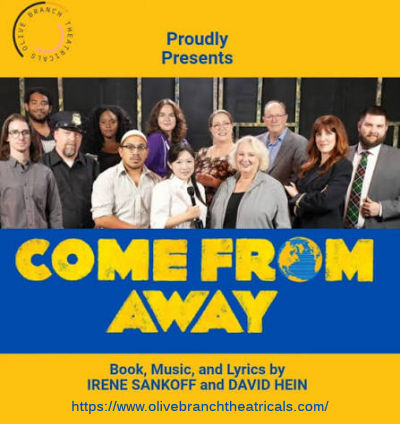
This is something that was going through my mind today as I saw the EXCELLENT production of Come From Away at Olive Branch Theatricals in Valencia (Santa Clarita). There are many productions of Come From Away in Southern California right now, including one that is well publicized over in Pasadena at A Noise Within (which starts tonight). You’re going to be seeing many many more in the days and months to come; for example, Chance Theatre is doing the show in January 2027.  But we specifically chose to see the show at Olive Branch, and reworked our schedule to fit it in. The reason is important.

Back in 2006, when I started getting back into heavy theatre attendance and writing up the shows I went to, one of our favorite small theatres was REP East in Santa Clarita. They did consistently great productions, but alas, they went away. In their space, another theatre opened, this time run by the City of Santa Clarita: The Main. The Main booked all sorts of shows into their tiny black box space, and helped (together with established venues like Canyon Theatre Guild) revitalize Main Street Newhall and the theatre scene in Santa Clarita. Out of their hard work, companies like Olive Branch Theatricals were formed: To do ambitious professional level theatre in Santa Clarita, and in doing so, upping the overall quality of theatre in the area. Alas, in August 2026, the entire block where The Main was located burned to the ground. We felt it was VITALLY important to keep supporting live theatre in our backyard, in Santa Clarita. So we specifically chose to see Olive Branch’s production of the show. It would also give us the opportunity to see the Olive Branch venue (they are located inside the Valencia mall), and to assess the overall quality of their work.

I’m pleased to say that our mission was a success. We came back VERY impressed. Olive Branch converted a former retail space (I’m guessing either Contempo Casuals or Charming Charlie) into a black box theatre on the dining / plaza level of the mall. There are under 99 seats, and the nature of the venue appears to allow flexible repurposing of the space. The major problem is that it isn’t a purpose-built space, so the seating isn’t raked. But the venue works well enough and the company has been very ambitious in the shows they are attempting, with a mix of larger musicals (they did Anastasia recently) to a mix of dramas. The quality of the performance was also very strong. The actors tend not to be AEA, but they have strong skills from film and TV in the area, as well as numerous other local intimate theatre productions. The upshot is: We’ll be back—they have a number of shows projected for 2027 that appear to be of interest. It also looks like they are providing a home to productions that lost theirs due to the fire; in particular, the production of Every Brilliant Thing we had hoped to see at The Main in September appears to have relocated to OBT the weekend of November 13.

But what did you think of the show, Mrs. Lincoln?

We first saw Come From Away at the Ahmanson Theatre in 2018. We saw it again at the Ahmanson in 2022. We love the show. We love the music. We love the message. We love the humor. It is one of those shows that uplifts you; that makes you realize the good that is in people if you just give them the chance. More on that in a minute.

Here’s what I wrote when I first saw this show back in 2018:

For those unfamiliar with the story behind Come From Away: It tells the story of the small town of Gander, Newfoundland. A small town of perhaps 7,000, it was at one time a major airport with the responsibility of fueling any trans-Atlantic flight. But by 2001, jets had rendered that function obsolete, and they had perhaps a half-dozen flights a day.

Then 9/11 happened. Then the US airspace was closed, and every flight destined for the US was diverted to the nearest airport. For 38 jets from across the world, that airport was YQX, Gander. With no notice, this small town saw its population double, and a need to accommodate, feed, and take care of passengers from these 38 planes for almost a week.

They stepped up. They did. They made friendships. They demonstrated the human spirit of caring and compassion. They didn’t asked to be paid, or for any compensation.

Come From Away is this story. Authors, composers, and lyricists Irene Sankoff and Devid Hein take the thousands of citizens of Gander, and the thousands of airplane passengers, and tell their story with just 12 actors. Under the direction of Christopher Ashley, it becomes a theatrical fugue or theatrical tapestry, weaving together different voices / threads that come together, when viewed at a distance and as a completed whole, that ultimately is captured in the refrain, “Welcome to the Rock”. It is that phrase, “welcome”, that is at the heart of this piece — and that welcome is successful because it is part and parcel with the notion of respecting the Come-from-aways because, ultimately, they are Islanders as well.

This year marked the 25th anniversary of 9/11. America, as a nation, is much more divided. Political leaders have exploited hatred—in particular hatred and fear of the other—to divide. Our political leaders have destroyed our relationship with our neighbor to the north, Canada. Where once they are friendly to the USA, the tariffs and posturing of the 47 administration have soured the relationship, to the point where Canada is much more independent, and turning much more towards the EU for their friendship. But the musical Come From Away reminds of the those better times, those better relationship. It reminds us that the people of Canada are good people, and we can have good relationships if we see them as people like us. Perhaps this administration needs to see more Come From Away, and less Evita and the Andrew Lloyd Webber canon.

Yesterday, I wrote about seeing The Outsiders at Broadway in Hollywood. This was a show filled with teen angsts, with drama, with violence, with anger, with societal clashes between classes, with death and fighting. It was a real downer, and I don’t really care to see it again. Come From Away, on the other hand, is uplifting. There is great music. There are uplifting people doing good without asking for something in return. There is love and friendship. In this divided era, this is what we need to see. Perhaps this is why so many companies are mounting Come From Away, and having great success with the show.

It doesn’t help that the musical is deceptively simple to put on (although I don’t know licensing costs). Twelve actors. A set that primarily consists of a large number of chairs. Lots of costumes, but none very elaborate. Your biggest expense is live music (if you go that route), having good choreograph, and a good dialect coach. If you cast strong actors and dancers, given the strong material, the show will be successful.

The Olive Branch production succeeded in most of those areas. The main one lacking was the use of live music: the lack of musician credits in the program makes me believe that OBT used recorded performance tracks from MTI. That’s not a surprise for a small company, but live music is always preferred.

The casting of the show was very strong. I could go on and say good things about every cast member: they were all that strong. In fact, I would, but I can find only so many superlatives in the thesaurus. I do want to highlight a few of the performances. Lauren Leland was outstanding as Capt. Beverly Bass and her other characters. She had a remarkably strong singing voice, but I also noticed the small mannerisms and facial expressions that brought her character to life. I also particularly liked Rachel Kellum’s Hannah and Tammie Pearson Richards’ Beaulah. They brought wonderful characterizations to the roles. Lastly, we always enjoy seeing Meggan Taylor on stage; we’ve know her for years and she brings a special something to her roles. On the male side, we enjoyed Ed Hill’s characterization of Nick, Castello Domingo’s characterization of Ali, Brandon McCravy’s Claude. We also enjoyed whoever played the rabbi. But, as I said, all of the performances were remarkable (especially when you consider that most of these folks don’t make their living as stage actors).

I also particularly noted the choreography. This is a tricky dance show, with a large number of dances that incorporate celtic dance steps as opposed to the traditional modern or ballet dance. The performance team executed them flawlessly, which is likely the result of a talented choreography team, led by Musette Caing Hart.

The direction team of Timothy Hart and Colin Sickafoose also did a good job. I often have trouble separating what the actor brings to a role from what the director brings. But in Come From Away, the director’s job is clear: They have to manage and work with all the actors to create multiple different characterizations from a single person. They have to create multiple distinct dialects from one individual, they succeeded. About the only weakness was that the firefighter’s mother, when adopted that persona, needed a stronger New Yawk accent (it came through near the end, but not as much during).

Were there any flaws? A few minor things. I found the moving lights at the top of the stage to be distracting at times, when they were aimed up and moving fast. The eyes tend to catch motion, and so that distracted. There were a few microphone glitches, in a venue that likely only needed amplification to be heard over the recorded instrumentation. That’s about it.

In short, this was an excellent production, and showed off Olive Branch Theatricals quite well. I’d encourage you to go see it, but the show we saw was the last one. So instead, I’m going to encourage you to do two things. First, go out to the Olive Branch Theatricals website and The Olive Branch website, and get tickets to other shows they will be doing. Second, determine what companies near you are doing Come From Away, and support them. Especially support the small companies that can really use your attendance. You might discover a company that you love.

Credits

Come From Away. Book, music, and lyrics by Irene Sankoff and David Hein. Directed by Timothy Hart & Colin Sickafoose. Choregraphed by Musette Caring Heart.

Cast: Michael Colon Bob, and others; Castello Domingo Kevin J, Ali, and others; Ed Hill Nick Marson, Doug, and others; Rachel Kellum Hannah, and others; Lauren Leland Annette, Captain Beverly Bass, and others; Brandon McCravy Claude, and others; Samantha Georgette Reed Bonnie Harris, and others; Tammie Pearson Richards Beulah Davis, and others; Ryan Stair Kevin T., and others; Meggan Taylor Diane Gray, and others; Jeremy Thompson Oz, and others; Yu Tsutsumi Janice Mosher, and others.

Music Department: Robby Good Music Director; August Eriksmoen Orchestrations; Ian Eisendrath Arrangements. Performance tracks likely provided by Music Theatre International (MTI), which provided all authorized performance materials.

Production and Creative: Timothy Hart and Colin Sickafoose Directors; Musette Caing Hart Choreography; Emily Pandise Props; Jeremy O’Brien Lighting Design; Chloe Koons Stage Manager; Natalie Arrendondo & Emily Holmen OBT Props; Jessica Morent, Ryan Sotdart, & Casey Padilla OBT Stage Managers and Crew; Colin Sickafoose OBT House Manager; Annette Sintia Duran OBT House Choreographer; Janet McAnany OBT Costume Director; Jeff McAnany OBT Marketing & Outreach; Jeremy O’Brien Facilities & Technical Direction.

Administrivia

I am not a professional critic. I’m a retired cybersecurity professional, a roadgeek who does a highway site and a podcast about California Highways, and someone who loves live performance. I buy all my own tickets, unless explicitly noted otherwise. I do these writeups to share my thoughts on shows with my friends and the community. I encourage you to go to your local theatres and support them (ideally, by purchasing full price tickets, if you can afford to do so). We currently subscribe or have memberships at: Center Theatre Group/Ahmanson Theatre; Broadway in Hollywood/Pantages Theatre; Pasadena Playhouse; The Soraya, Chromolume Theatre, and 5-Star Theatricals.

Want to find a show: Check out the Theatre Commons LA show list. Other good lists are the Theatre in LA listings; the TodayTix listings; OnStage 411 (use the “shows” drop down); and Theatermania. If you are looking for discount tickets, TodayTix (unlike their predecessor Goldstar Events) doesn’t handle the small theatres in LA. Luckily, Theatre Source LA has a new initiative: StageRushLA for discount tickets.

Sadly, we recently lost one of my favorite theatrical venues due to fire: the historical building housing Newhall Refinery, Care/Tucker Design, The Main, and El Troc was destroyed by a 3-alarm fire. Luckily, Canyon Theatre Guild next door was spared. I’ve been attending “The Main”, and it’s previous incarnation, Rep East Playhouse, since all the way back in 2006. Twenty years. Let’s pour a glass for the art and artists of Rep East/The Main, and hope that small and vital venues like The Main return to Santa Clarita soon. While you’re at it, contribute to support the artists of The Main who lost all their gear (they were in the middle of a show run). Do what you can to support theatre in Santa Clarita. I am: Our outing today for Come From Away is to the Olive Branch Theatricals production, in the Valencia Town Center. The leaders there got their start through REP and CTG.

Upcoming

Key: 🎭 Theatre / 🎼 Music / 🎙 Other Live Performance – Next 90ish Days (🎫 indicates ticketing is pending).

===> Click Here To Comment <==This entry was originally posted on Observations Along the Road as 🎭 Best of Times, Worst of Times | "Come From Away" @ Olive Branch by cahwyguy. Although you can comment on DW, please make comments on original post at the Wordpress blog using the link to the left. You can sign in with your LJ, DW, FB, or a myriad of other accounts. Note: Subsequent changes made to the post on the blog are not propagated by the SNAP Crossposter; please visit the original post to see the latest version. P.S.: If you see share buttons above, note that they do not work outside of the Wordpress blog.

cahwyguy: (Default)

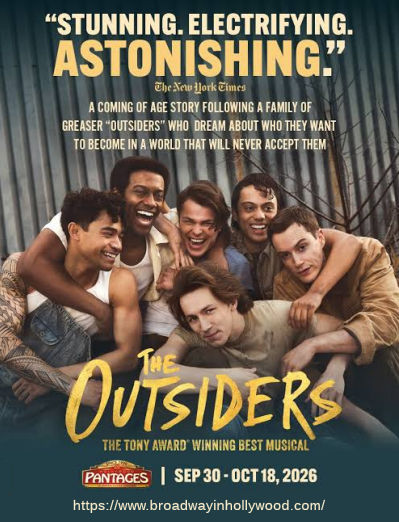
The Outsiders (BIH/Pantages)There are some shows you instantly love; the recent Water for Elephants is a great example of that. There are others that just never hit right, and you think about leaving; Girl From the North Country was one of those for us. The Outsiders, which we saw last night at Broadway in Hollywood/Hollywood Pantages, was—for us—a big “meh”.

I’m not saying that the show was bad, for it wasn’t. It won Best Musical, although I do think there were other shows in the season that were better. It drew an active and interested younger audience, which is great for the theatre. One could follow the story, which was dark and dramatic. It had loads and loads and loads of teen angst. The performances were very strong. There were a few catchy songs.

But it just wasn’t our thing. My wife left and sat in the lobby before intermission: the story was way to dark for her. I sat through the whole thing, but the story never drew me in. It’s not a musical I would care to see again: there are only a few catchy songs, and really one one (“Stay Gold”) that I think was a very strong song. This wasn’t a song and dance show. It was dark, with violence, death, sexual violence, domestic violence, gang violence, and borderline racism. There are ways to handle that: just look at Carousel. But this just didn’t grab me. Perhaps it would be different if I had seen the movie.

There’s a long detailed synopsis of the story on Wikipedia. I asked Gemini to summarize it. [Note that there are SPOILERS for Act II. I’ve tried to make Act II harder to read; highlight it if you want the spoilers]:

Act I introduces Ponyboy Curtis, a 14-year-old growing up in Tulsa, Oklahoma, in 1967. He navigates a fractured world divided by socioeconomic status, where his working-class gang, the Greasers, faces a violent rivalry with the wealthy Socs. After Ponyboy is attacked by the Socs, tensions steadily escalate. He and his best friend, Johnny Cade, meet a Soc girl named Cherry Valance at a drive-in, sparking mutual understanding but provoking a fierce confrontation with her drunk boyfriend, Bob. Later that evening, after a heated argument with his oldest brother and guardian, Darrel, Ponyboy runs away with Johnny. The two are cornered in a park by Bob and his gang, who attempt to drown Ponyboy in a fountain. To save his friend, Johnny stabs and kills Bob, forcing both boys to flee the city and hide in an abandoned church with the help of their hardened friend, Dally.

Act II follows the fallout of Bob’s death as the Socs declare an all-out war on the Greasers. While hiding out, Johnny decides he wants to return home and turn himself in, but tragedy strikes when the church catches fire. Johnny and Ponyboy bravely rush inside to save a group of children trapped inside, cementing themselves as local heroes. However, Johnny is severely injured by a falling beam, leaving him paralyzed in the hospital. Seeking retribution, the Greasers engage the Socs in a brutal rumble in the pouring rain and emerge victorious, but the triumph is short-lived as Johnny dies from his injuries shortly after. Driven mad by grief, Dally intentionally gets hit by a train and dies, leaving Ponyboy utterly distraught. Ultimately, Ponyboy finds a path forward after reading a heartfelt letter Johnny left behind. He reconciles with his brothers and begins writing down their collective story, which is revealed to be the opening lines of The Outsiders novel.

As you can see, a very dark story. Not your typical musical. Not our cup of tea. But I’m not saying it was bad; it just wasn’t something we would choose to see, or that we would particularly want to see again.

Before I go into the strengths of the show, I want to highlight one other problem—and this one isn’t show related, it is theatre related. For the first time that I can recall at the Pantages, there was tremendous bass music bleedthrough from the venue next to the Pantages (Audience Left, Stage Right). This bass—especially strong during the second, most dramatic act—was distracting and annoying. I’ve never had that happen before, and the Pantages staff needs to talk to the Frolic Room about the noise. Hopefully, it was a one-time thing.

That said, the staging was very strong. There were a number of things that struck me. First, the lighting design by Brian MacDevitt was very strong. It created the right mood, especially in the second act. I particularly noted the lighting during the fighting in the rain in the second act. Second, and again this relates to the fighting scene: The rain was very effective, and it is a difficulty and messy effect to have on the stage. Most shows avoid the problem by using projected rain. This was using real water, and when you combine that with the strange sand-like substance on the stage, it was really effective. Overall, the scenic design was interesting, with a dark junkyard feel and abandoned cars and tires. Very effective.

Performances were strong. At our performance, we had a swing understudy on for Ponyboy (Jordan Deandre Williams), and he was spectacular. Tyler Jordan Wesley was also very strong as Dallas, and Emma Hearn was great as Cherry Valance. A few other notables: Gabriel White Marín was strong as Bob, and Delaney Dias was a very strong dancer as Ace.

I’ve talked about the story and the performances. Turning to the music. Most of it was equally dark and, truthfully, didn’t catch my eye. I liked the opening and closing numbers, “Tulsa 1967”, as well as the gentle number “Stay Gold”. The rest, although they served the show, weren’t particularly memorable.

As you’ve probably figured out by now, this wasn’t the show for me. It wasn’t a bad show—it just wasn’t a show I liked. Our show today should be much better, as it is one of our favorites (Come From Away). But the real question is not us, but you. Should YOU see The Outsiders?

I think the answer is a definite maybe. If you are triggered by the subject matter of the show: domestic violence, suicide, sexual violence, racism—I’d avoid the show. If you don’t like really dark themes—avoid the show. Do not go in expecting a song and dance spectacular like Boop. This is much darker than the violence in Water for Elephants. It doesn’t have light numbers. It is definitely a PG-13 or R rated audience show for the themes.

If given all that doesn’t bother you, then go see the show. The performances are spectacular, and the staging is wonderful. Tickets are available through the Pantages website.

A last note for those reading this on my blog: I’m still working on the election analysis posts. Some of the work is easy for those offices still on the ballot from the Primary. But there are lots of Propositions at the state, city, and county level; there’s a whole new set of state-level judges, and there are LACCD trustees. Combine that with the upcoming show schedule, and I’d look for the ballot deep dive in 7-10 days, perhaps sooner. You can look for the Come From Away writeup sometime tomorrow, and perhaps a new podcast episode near the end of the week (if I get the editing done).

Credits

The Outsiders. Book by Adam Rapp and Justin Levine. Music and Lyrics by Jamestown Revival (Jonathan Clay & Zach Chance) and Justin Levine. Based on the novel by S. E. Hudson and the movie directed by Francis Ford Coppola. Directed by Danya Taylor. Choreography by Rick Kuperman & Jeff Kuperman.

Cast [underscores indicate “at our performance”; strikeouts indicate “not at our performance”; ↑ indicates “swung up”]:  Nolan White Jordan Deandre Williams Ponyboy Curtis; Bonale Fambrini Johnny Cade; Tyler Jordan Wesley Dallas Winston; Travis Roy Rogers Darrel Curtis; Corbin Drew Ross Jackson Reagin Sodapop Curtis; Emma Hearn Cherry Valance; Jaydon Nget Two-Bit; Gabriel White Marín Bob / Cop; Dante D’antonio Paul; Seth Ajani Guiseppe Little Ensemble; Christian Arredondo Tommy Kaiser Ensemble; Kevin Avila Brill, Ensemble; Delaney Diaz Ace; Gina Gagiano Ensemble; Will Hastreiter Brian Ho Pui Cheung Ensemble; Katie Riedel Marcia; Luke Sabracos Hayden Rivas Trip; Eli Talley Ensemble; Johnathan Tanner Tyson Hill Chet; Rodney Thompson Jr Steve; Alyssa Villareal Beverly; Swings: ↑ Brian Ho Pui Cheung, ↑ Tyson Hill, Hannah Jennens, ↑ Tommy Kaiser, ↑ Hayden Rivas Dance Captain; ↑ Jordan Deandre Williams, ↑ Guiseppe Little.

Music Department (🌴 indicates local): Justin Levine Music & Lyrics, Music Supervision, Arrangements, Orchestrations; Jamestown Revival Music & Lyrics; Matt Hinkley Music Supervision; Remy Kurs Music Director, Conductor; Adam Dorfman Assoc Conductor, Keyboard; Jackson Dunkin, Andrew Shield Guitars; Anthony Scandora Drums; Bella Amada Bass; Justin Brown Reeds; Anna Nordmoe Violin; E. Renée Gamez Asst Conductor, Keyboard Cover; 🌴 Ira Glansbeek Cello; 🌴 Jeff Driskill Tenor Sax, Bari Sax, Clarinet; 🌴 Michael Abraham Guitar 2 (Electric/Steel-String Acoustic); 🌴 Dan Lutz Bass (Acoustic/5-String Electric/Fretless); 🌴 Eric Heinly Orchestra Contractor; Kristy Norter Music Coordinator; Emily Grishman Music Copying; Alden Terry Music Preparation; Randy Cohen Keyboards Keyboard Programmer; Enrico de Trizio Ableton Programmer; Andrea Yohe Assoc Music Supervisor; Ed Benrock, Jamie Eblen, Mark G. Meadows, and Justin Smith Additional Arrangements.

Production and Creative: S. E. (Susie) Hinton Author; Adam Rapp Book; Justin Levine Book; Danya Taymor Director; Rick Kuperman & Jeff Kuperman Choreography; AMP featuring Tatiana Kahvegian Scenography; Sarafina Bush Costume Design; Brian Macdevitt Lighting Design; Cody Spencer Sound Design; Hana S. Kim Projection Design; Jeremy Chernick & Lillis Meeh Special Effects Design; Alberto “Albee” Alvarado Hair & Wig Design; Tishonna Ferguson Makeup Design; Taylor Bense Sound Effects Specialist; Jack Viertel Creative Consultant; Miranda Cornell Assoc & Resident Director; Autumn Angelettie Assoc Director; Kristen Carcone Assoc Choreographer; Nancy Renee Braun Choreography Supervisor; Gigi Buffington Speech Text & Dialect Coach; Beverly Jenkins Production Supervisor; Edmond O’Neal Production Stage Manager; Travis Blackwell Stage Manager; Julia Formanek Asst Stage Manager; The TRC Company Casting; Allied Global Marketing Tour Marketing & Press; The Road Company Tour Booking; Juniper Street Productions Production Management; 321 Theatrical Management General Manager.

Administrivia

I am not a professional critic. I’m a retired cybersecurity professional, a roadgeek who does a highway site and a podcast about California Highways, and someone who loves live performance. I buy all my own tickets, unless explicitly noted otherwise. I do these writeups to share my thoughts on shows with my friends and the community. I encourage you to go to your local theatres and support them (ideally, by purchasing full price tickets, if you can afford to do so). We currently subscribe or have memberships at: Center Theatre Group/Ahmanson Theatre; Broadway in Hollywood/Pantages Theatre; Pasadena Playhouse; The Soraya, Chromolume Theatre, and 5-Star Theatricals.

Want to find a show: Check out the Theatre Commons LA show list. Other good lists are the Theatre in LA listings; the TodayTix listings; OnStage 411 (use the “shows” drop down); and Theatermania. If you are looking for discount tickets, TodayTix (unlike their predecessor Goldstar Events) doesn’t handle the small theatres in LA. Luckily, Theatre Source LA has a new initiative: StageRushLA for discount tickets.

Sadly, we recently lost one of my favorite theatrical venues due to fire: the historical building housing Newhall Refinery, Care/Tucker Design, The Main, and El Troc was destroyed by a 3-alarm fire. Luckily, Canyon Theatre Guild next door was spared. I’ve been attending “The Main”, and it’s previous incarnation, Rep East Playhouse, since all the way back in 2006. Twenty years. Let’s pour a glass for the art and artists of Rep East/The Main, and hope that small and vital venues like The Main return to Santa Clarita soon. While you’re at it, contribute to support the artists of The Main who lost all their gear (they were in the middle of a show run). Do what you can to support theatre in Santa Clarita. I am: Our outing today for Come From Away is to the Olive Branch Theatricals production, in the Valencia Town Center. The leaders there got their start through REP and CTG.

Upcoming

Key: 🎭 Theatre / 🎼 Music / 🎙 Other Live Performance – Next 90ish Days (🎫 indicates ticketing is pending).

===> Click Here To Comment <==This entry was originally posted on Observations Along the Road as 🎭 A Tulsa Story: 67 not 66 | "The Outsiders" @ BIH/Pantages by cahwyguy. Although you can comment on DW, please make comments on original post at the Wordpress blog using the link to the left. You can sign in with your LJ, DW, FB, or a myriad of other accounts. Note: Subsequent changes made to the post on the blog are not propagated by the SNAP Crossposter; please visit the original post to see the latest version. P.S.: If you see share buttons above, note that they do not work outside of the Wordpress blog.

cahwyguy: (Default)

Another quarterly cycle of updates to the website is complete. Here’s the changelog. Bottom Line: In addition to all the changes from headlines and various posts and emails, significant changes include: the addition of a load of new maps, including survey maps for Placer County; a link to a post with the history of Camp Hess Kramer; the passage of a lot of bills and resolutions at the end of the legislative cycle for the year; and loads of interesting actions from the CTC if you dig and read through them.
This update covers July, August, and September 2026. Before we dive into the updates to the California Highways site, an update on the California Highways: Route by Route podcast. As always, you can keep up with the show at the podcast’s forever home at https://www.caroutebyroute.org , the show’s page on Spotify for Podcasters, or you can subscribe through your favorite podcaster or via the RSS feeds (CARxR, Spotify for Podcasters). The following episodes have been posted since the last update on June 27, 2026:

  • July | CA RxR 4.13: Route 14: The Antelope Valley Freeway. Episode 4.13 continues our exploration of Route 14, picking up from the end of the first segment at I-5, and continuing to the junction with US 395 near Inyokern. As usual, along the way, we explore the history of the route, the conversion to freeway, major projects on the route, and naming along the route. This includes a detailed exploration of the start of the route in the Newhall Pass and Solemint area. It also includes an exploration of the “Aerospace Highway” name, and all the firsts that occurred at Edwards AFB and the test center next to the highway. Ep. 4.13 marks the end of the main episodes of Season 4, although we do have a couple of bonus episodes planned for the season break to tide you over. The first bonus episode, 4.14, covers New Idria Road and Hites Cove Road, which are mining roads in San Benito and Mariposa counties. (Spotify for Creators)
  • July | CA RxR 4.14: Bonus: New Idria Road and Hites Cove Road. Episode 4.14 is the first of two bonus episodes. It tells the story of the corridors of New Idria Road and Hites Cove Road. Both of these historic highway corridors lead to mining in Central California. This episode is based off blogs released on Gribblenation during October 2025 and May 2026. New Idria Road is an approximately 21.5-mile rural highway located in the Diablo Range of San Benito County. It branches off of Panoche Road, and winds its way south-ish through the Diablo range to the ghost mining town of Idria, continuing as Clear Creek Road. Hites Cove Road is an approximately seven-mile rural highway corridor located in the Sierra Nevada range of Mariposa County, south of Route 140, and west of El Portal. Hites Cove, and its successor forest and OHV trail roads, leads to the ghost town of Hites Cove on the south fork of the Merced River. Two interesting stories about two interesting ghost towns. Next up: Our second bonus episode to close out Season 4: A roundtable discussion with Adam Prince and Doug Kerr as we celebrate the 25th anniversary of the start of Gribblenation. (Spotify for Creators)
  • August | CA RxR 4.15: Bonus: 25 Years of Gribblenation. Episode 4.15 is the second of two bonus episodes. The year 2026 marks 25 years since Adam Prince, Doug Kerr, and Brian LeBlanc started the website. This episode features a discussion with Daniel, Tom (a Gribblenation contributor), Adam, and Doug about the past, present, and future of Gribblenation. Learn the story of how the site came to be, how the name was chosen, the hiccups along the way, and where the site is today. More importantly, learn the philosophy behind Gribblenation: To not only tell the facts and the history of the roads, but to tell the stories behind the roads. Next update: Coming sometime in late September 2026 will be Season 5 of the podcast, starting with the story of Route 15 and I-15 between San Diego and Temecula. (Spotify for Creators)
  • September | CA RxR 5.01: I-15 (Part 1): South of Temecula. Welcome to Season 5. We start the season with three episodes covering Route 15. The first (this episode), covers LRN 15, Sign Route 15, and today’s Route 15 between San Diego and Temecula. LRN 15 ran from what is now Route 1 near Fort Bragg to what is today’s I-80 near Emigrant Gap; it is today’s Route 20. Sign Route 15 is what became Route 7 and later I-710, and is today’s Long Beach Freeway. We have some interesting exploration of the ends of Sign Route 15 in Pasadena and Long Beach. We then turn to the main focus of the episode: Route 15, which runs from San Diego to the Nevada border, and has a complicated history. So complicated, in fact, that this episode focuses only on the portion between San Diego and Temecula, exploring both former Route 103 and US 395, as well as the transition from US 395 to today’s I-15 routing. Episode 5.02 will cover Temecula to Devore, and explore the history of I-15, I-15E, I-215, Route 71, US 91, US 395, and Route 194. Lastly, Episode 5.03 will cover Devore to Nevada, including I-15, US 395, US 66, US 91, and US 466 (with a bit of Route 195 and US 95 thrown in). (Spotify for Creators)

Turning to the updates to the California Highways pages: Updates were made to the following highways, based on my reading of the (virtual) papers and my research for the fifth season of the podcast in July, August, and September 2026 (which are posted to the roadgeeking category at the “Observations Along The Road” and to the California Highways Facebook group) as well as any backed up email changes. I also reviewed the the AAroads forum (Ꜳ). This resulted in changes on the following routes, with credit as indicated [my research(ℱ), contributions of information or leads (via direct mail or ꜲRoads) from Fred Akbar (FredAkbar)(2), Concrete Bob(3), Nathan Edgars (NE2)(4), Tom Fearer(5), Andy Field (andy3175)(6), Gonelookin(7),Adrian Ople(8), Mike Palmer(9), Plutonic Panda(10), Jim Rogers(11), Howard Schroeter(12), Tom Slater(13)]: Route 1(ℱ), Route 4(ℱ), I-5(ℱ), I-8(ℱ), Route 9(ℱ), I-10(ℱ,4,12), Route 12(ℱ,5), Route 14(ℱ), I-15(ℱ,6), Route 17(ℱ), Route 24(ℱ), Route 25(ℱ,5), Sign Route 26(ℱ), Route 26(ℱ), Route 29(ℱ), Route 34(ℱ), Route 36(11), Route 37(ℱ), Route 39(ℱ), Route 41(ℱ), Route 47(10), Route 49(ℱ), US 50(ℱ,9), Route 57(ℱ), Route 58(2,6,5), Route 64(ℱ), Former US 66(ℱ), Route 71(ℱ), Route 74(ℱ,6,10), Route 77(ℱ), I-80(ℱ), Route 84(ℱ), Route 85(ℱ), Route 86(ℱ), Route 88(5,7), Route 91(ℱ,6), Route 92(ℱ), Route 93(ℱ), Route 99(ℱ), US 101(ℱ,5), I-105(ℱ), Route 107(ℱ), Route 118(ℱ), Route 120(ℱ), Route 121(ℱ), Route 123(ℱ), Route 125(ℱ), Route 133(ℱ), Route 138(ℱ), Route 142(ℱ), Route 145(ℱ), Route 163(ℱ), Route 169(5), LRN 176(ℱ), Route 178(5), Route 180(5), Route 187(ℱ), I-215(4,12), Route 217(ℱ), Route 227(ℱ), Route 246(ℱ), Route 260(ℱ), Route 271(5), Route 299(ℱ), US 395(ℱ,5), I-405(ℱ), I-580(ℱ), I-605(ℱ), I-680(ℱ), I-710(9), I-880(ℱ), County Sign Route 66(ℱ), County Sign Route S26(8), County Sign Route S27(8), County Sign Route S28(8), County Sign Route S30(8), County Sign Route S32(8), De Anza Trail(9). Updated all the business route links, based on a post on AARoads. Added a link to the DeLeuw, Carther, & Company report, “Report on a Plan for Trafficways and Modifications to Railroad Operations and Facilities, Sacramento Metropolitan Area, Volume 1” to the Sacramento History Page(3).
(Source: private email through 10/1/2026, Highway headline posts through and including the September 2026 Headline post, AARoads through 10/1/2026)

Continued work on Season 5 of the Route by Route podcast. Research for and preparation of the episodes posted or written during this period resulted in changes and updates to the following routes: I-15, Route 16, Route 17, Route 18, Route 19, Route 30, Route 38, US 66, Route 71, Route 79, Sign Route 83, Route 85, US 91, US 95, Route 103, Route 130, Route 163, Route 164, Route 195, Route 206, I-210, Route 214, I-215, Route 238, Route 259, Route 262, I-280, Route 371, US 395, I-580, I-680, LRN 15, LRN 16, LRN 17, LRN 18, LRN 31, LRN 40, LRN 43, LRN 50, LRN 77, LRN 78, LRN 115, LRN 167, LRN 175, LRN 178, LRN 190, LRN 191, LRN 192, LRN 194, LRN 275, LRN 277, History of California Interstates.

Added some more GIS resources to the maps page. As a reminder: The California Highways Maps Page is often your best starting point for map-based research into California Highways. If readers are aware of any additional map-based resources I should add to that page, please let me know.

Updated Chargeable and Non-Chargeable Interstates and the Introduction to Interstate Highway Types pages to discuss the current funding formulas, and to clarify that the chargeable/non-chargeable distinction is more historic and less applicable today. Hat tip to Rothman on AARoads in this discussion for making me aware of the need to do another update pass on those pages.

Reviewed the online agenda of the California Coastal Commission for the July through September meetings. The following items were of interest:

  • September (Weds): Agenda Item 12.a. September 2026 Progress Report on the Caltrans Eureka-Arcata Hwy 101 Corridor Sea Level Rise Adaptation Plan. Informational update on Caltrans District 1’s progress on preparing a comprehensive adaptation plan for protecting, relocating, or otherwise adapting the Eureka-Arcata US 101 Corridor improvements authorized under CDP № 1-18-1078 to address anticipated sea level rise related flooding hazards.

Note that I also reviewed the CCC archives for information related to Camp Hess Kramer in Malibu. This was combined with other research, and led to a blog entry: “A Pre-History of Camp Hess Kramer“. This blog explores the history of camp property prior to the acquisition of the land by Wilshire Blvd Temple, including the history of Rindge Family ownership. I’m still looking for more information, particularly related to the history of the Yerba Buena School, the construction of Yerba Buena Road, and the construction of Decker Canyon Road (Route 23). The blog post also includes information on the future of Camp Hess Kramer and its sister camp, Gindling Hilltop Camp, as well as some records research. The post is also linked on the page for Route 1.

Reviewed the Pending Legislation page, based on the California Legislature site, for bills through 2026-10-01. As usual, I recommend to every Californian that they visit the legislative website regularly and see what their legis-critters are doing. As many people are unfamiliar with how the legislature operates (and why there are so many “non-substantive changes” and “gut and amend” bills), I’ve added the legislative calendar (updated for 2026) to the end of the Pending Legislation page. This is early in the even-numbered year session, so there’s a lot of introduction of placeholder bills, and a lot of amending of those placeholder bills (and bills that remained active from the previous year). Noted the passage of the following bills / resolutions (I also identified a number of errors in bills and resolutions, and submitted comments as indicated):

( Read more... )
cahwyguy: (Default)

And with the turning of a calendar page, we’ll be moving into October. The last quarter of the year. Halloween and Pumpkin Spice (yuk!). With marketing what it is, that means Christmas ads should be starting up any day now (sigh—a royal annoyance for those of us that aren’t Christian). As I wrote last month, leaves should be starting to fall, but instead we have hurricane humidity and moisture. That will likely be followed by Santa Ana winds, but who knows with the Super El Nino in play. For me, it also means the final stages of getting ready for ACSAC in December (registration is open), as well as the fall theatre season.

California Highways: Route by Route logoAs always, we start with updates on the California Highways: Route by Route podcast: Season 5 is written through 5.07; I’m taking a break from writing to do the California Highways Webpage updates (those should be completed after I process this headline post). After that, I’ll do my general election ballot deep-dive, and then get back to writing. We’ve recorded the first two episodes of Season 5, and posted 5.01. Episode 5.02 was recorded last night, so I’ll be editing it later this week. Zencaster is working well for recording the podcast, and I hope we’ve solved the microphone problems. I also got some more editing tips visiting a high school friend who has worked in terrestrial and internet radio, which I’ll try when I edit Season 5. Please let us know if it sounds better.

As a reminder: You can help our listening audience grow. Please tell your friends about the podcast, “like”, “♥”, or “favorite” it, and give it a rating in your favorite podcatcher. Share the podcast on Facebook groups, and in your Bluesky and Mastodon communities. Leave a review, and tell us about it. For those that hear the early episodes, the sound quality of the episodes does get better — we were learning. As always, you can keep up with the show at the podcast’s forever home at https://www.caroutebyroute.org , the show’s page on Spotify for Creators, or you can subscribe through your favorite podcatching app or via the RSS feeds (CARxR, Spotify for Creators) . The following episodes have been posted this month:

  • September | CA RxR 5.01: I-15 (Part 1): South of Temecula. Welcome to Season 5. We start the season with three episodes covering Route 15. The first (this episode), covers LRN 15, Sign Route 15, and today’s Route 15 between San Diego and Temecula. LRN 15 ran from what is now Route 1 near Fort Bragg to what is today’s I-80 near Emigrant Gap; it is today’s Route 20. Sign Route 15 is what became Route 7 and later I-710, and is today’s Long Beach Freeway. We have some interesting exploration of the ends of Sign Route 15 in Pasadena and Long Beach. We then turn to the main focus of the episode: Route 15, which runs from San Diego to the Nevada border, and has a complicated history. So complicated, in fact, that this episode focuses only on the portion between San Diego and Temecula, exploring both former Route 103 and US 395, as well as the transition from US 395 to today’s I-15 routing. Episode 5.02 will cover Temecula to Devore, and explore the history of I-15, I-15E, I-215, Route 71, US 91, US 395, and Route 194. Lastly, Episode 5.03 will cover Devore to Nevada, including I-15, US 395, US 66, US 91, and US 466 (with a bit of Route 195 and US 95 thrown in). (Spotify for Creators)

As a reminder: One of the sources for the highway page updates (and the raison d’etre for for this post) are headlines about California Highways that I’ve seen over the last month. I collect them in this post, which serves as fodder for the updates to my California Highways site, and so there are also other pages and things I’ve seen that I wanted to remember for the site updates. Lastly, the post also includes some things that I think would be of peripheral interest to my highway-obsessed highway-interested readers.

Well, you should now be up to date. Here are the headlines that I found about California’s highways for September 2026:

Key

[Ħ Historical information | $ Paywalls, $$ really obnoxious paywalls, and ∅ other annoying restrictions, such as demanding your email in order to display the article. I’m no longer going to list the paper names, as I’m including them in the headlines now. Note: For $ paywalls, sometimes the only way is incognito mode, grabbing the text before the paywall shows, and pasting into an editor. Using archive.ph usually works for these sites. See this article for more tips on bypassing paywalls. $$ paywalls are even more annoying. Archive.ph doesn’t work, and you may not be able to get the full details. 🎥 indicates a primarily video article. 🎩 indicates hat/tip to someone for finding this article. ✔ indicates that the article was processed as part of the recent “Updates to California Highways” cycle. ]

Highway Headlines

  • Richmond-San Rafael Bridge turns 70 (The Bay Link Blog) The Richmond-San Rafael Bridge opened to the public 70 years ago this week. It was on Aug. 31, 1956, when Gov. Goodwin Knight dedicated the bridge. The next day, Sept. 1, the John F. McCarthy Memorial Bridge – as it has been officially known since 1981 – opened for traffic. McCarthy was a state senator from Marin between 1950 and 1970 and a former Republican Senate majority leader who sponsored the bill authorizing the construction. There had long been talk of a bridge linking Marin and the East Bay, but the real impetus for the span came after a two-month ferry strike in 1947, followed by a second five-month walkout in 1949.
  • California Invests 2.7 Billion Dollars to Improve Highway Safety, Enhance Transit Options and Prepare for a Changing Climate (Caltrans) The California Transportation Commission (CTC) has approved $2.7 billion in funding for more than 150 new projects designed to improve travel times, increase multimodal options and strengthen the state’s transportation assets against severe weather and other climate-related threats. These investments align with Governor Gavin Newsom’s build more, faster agenda, delivering critical infrastructure upgrades and creating thousands of jobs across the state. Of the combined total, nearly $1.6 billion is funded by the federal Infrastructure Investment and Jobs Act of 2021 (IIJA) and another $542 million from California’s Senate Bill 1 (SB 1), the Road Repair and Accountability Act of 2017. […] This month’s list of approved projects includes:
  • Security Paving Begins Caltrans SR 91 Sign Rehab Work (Construction Equipment Guide | 🎩 Plutonic Panda) Following several months of site preparation and preconstruction activity, including the placement of protective K-rail barriers, Security Paving Co. Inc. has begun active operations on the California Department of Transportation’s $34 million State Route 91 Sign Rehabilitation Project. The three-year asset-management initiative spans a 14.7-mi. corridor of SR 91 in Los Angeles County, stretching from Vermont Avenue in Gardena east to postmile 20.7 at the Orange County line in Cerritos. The highway segment, constructed between 1970 and 1985, features five traffic lanes in each direction and carries up to 284,000 vehicles daily, according to 2024 Caltrans traffic census data.
  • $ A $276 million project will be Caldecott Tunnel’s biggest upgrade since 2013. Here’s what it will do. (The Mercury News | 🎩 gonealookin) The Caldecott Tunnel, a major thoroughfare between Contra Costa and Alameda counties, is poised for a major renovation backed by $267 million in federal and state funding, state officials recently announced. The project will be the most extensive investment in the tunnel since the addition of the fourth bore, completed in 2013, which exposed just how much of an upgrade the other three tunnels needed, said former Orinda Mayor Amy Worth, who served as chair of the Metropolitan Transportation Commission and was a key player in getting the fourth tunnel built in the early 2000s. Locator map of the Caldecott Tunnel“The Caldecott Tunnel has always been a very critical, vital transportation link between Contra Costa County and the rest of the Bay Area,” Worth said. “I am really grateful for Caltrans. We’ve been talking about the need to upgrade the tunnels and it is joyous news that this is in the budget and will be moving forward.” (Archived)
  • Pine Valley Creek Bridge (FB/San Diego Uncovered) Thousands of people cross a national engineering first every day on the way to Yuma and have no idea. 🌉 The Pine Valley Creek Bridge carries Interstate 8 across a canyon in the Cleveland National Forest, about 450 feet above the creek bed. Its twin spans run roughly 1,700 feet each. Opened in 1974, it was the first bridge in the United States built using the cast-in-place segmental balanced cantilever method — concrete segments poured in place and extended outward from each pier, arm by arm, until the arms met in the middle over empty air. No falsework rising from the canyon floor. No scaffolding in a watershed nobody wanted to disturb.
  • California Forever project to bring shipbuilding to Collinsville put on hold – for now (Vallejo Sun | 🎩 bing101) The Solano County Board of Supervisors voted 3 – 2 to postpone approval of legislation backed by California Forever related to shipbuilding and maritime manufacturing development in Collinsville, pending further review and clarification. Supervisor Monica Brown and Supervisor John M. Vasquez voted no. The board plans to revisit the issue well before the legislature opens again in January. Collinsville is a small unincorporated community at the mouth of the Sacramento River — a deep water ship channel — about 14 miles south of Travis Air Force Base and eight miles southwest of Rio Vista. California Forever owns or controls 69,000 acres of land in the area and has been pushing for the development of a sdhipyard at the site.
  • $ State rolls out $330 million in Highway 37 project grants (Daily Republic) The California Transportation Commission on Thursday approved more than $330 million in grants toward the Highway 37 rehabilitation project. The funding includes $220 million in State Highway Operation and Protection Program and state General Fund money for the Novato Creek Bridge replacement project plus another $14.1 million for related environmental and storm water mitigation work as well as $62.7 million through the state Transportation Improvement Program and the Local Transportation Climate Adaptation Program. Another $32.3 million in SHOPP funds for Phase 1 of the Sears Point-to-Mare Island Improvement Project also was approved. (Archived)
  • Lankershim Blvd Opens (Metro Primary Resources) Lankershim Boulevard opens to traffic under a newly completed Hollywood Freeway overpass as part of the “Barham-to-Vineland” segment of US-101. (The first section of the freeway opened on June 15, 1940).
  • L.A. County’s 60 Freeway faces a 2-mile overnight shutdown this Labor Day weekend ahead of a $441M interchange overhaul (Secret Los Angeles) Drivers heading through the San Gabriel Valley this weekend should plan around a major overnight freeway closure: all westbound lanes of the 60 Freeway will be closed in Diamond Bar. The full closure is scheduled for Saturday and Sunday mornings as crews continue work on the massive 57/60 Confluence Project, a long-term effort aimed at improving safety, traffic flow, and congestion at one of the region’s busiest freeway interchanges, NBC Los Angeles reports.
  • $ L.A. freeways, roads to be closed to general traffic for 2028 Olympics. How will it hit your commute? (Los Angeles Times) Hundreds of miles of freeways and streets across Southern California will be turned into restricted roadways for exclusive use by permit holders during the 2028 Olympics under a plan to ensure smooth travel for visitors, athletes and staff in a region notorious for heavy traffic, according to reports and drafts of the project reviewed by The Times. The restricted lanes are expected to include major freeways that cut across Los Angeles, Orange and San Diego counties and connect game venues with the Olympic villages, where athletes and coaches will stay. Instead of navigating congested freeways and roads, those granted exclusive permits would be allowed to cut through traffic under what is known as the 2028 Olympic’s “Games Route Network.”
  • 🎥 Sacramento region says goodbye to call boxes after more than 30 years – YouTube (CBS News Sacramento) They’re a piece of Sacramento-area history, call boxes that once served as a lifeline for drivers before cellphones became commonplace. Now, the Sacramento region is hanging up the phone.
  • California county ‘resistant to change’ reckons with new main street (SF Gate) In a distant corner of California, the beating red heart of Modoc County is a set of traffic signals where two major highways intersect. Located on four corners in Alturas, where Highway 395 T-bones into Highway 299, the only traffic lights in the entire county are perhaps the most symbolic stop signs in the state. This far-removed frontier resists the temptations of change, as many in Modoc pride themselves on a dignified defiance to urban living and values. Its roughly 8,700 residents live among nearly 4,000 square miles, a perfectly square land mass that’s almost as big as Los Angeles County and that’s largely composed of an unfettered, federal forest.
  • Glendale-Hyperion Complex of Bridges Project (FB/City of Los Angeles Bureau of Engineering) The Glendale-Hyperion Complex of Bridges Project is advancing work to realign the I-5 Glendale Boulevard off-ramp. This improvement is designed to enhance traffic safety and improve traffic flow. This important upgrade will help create a safer and more efficient roadway for everyone who travels through the corridor.
  • NDOT meeting to discuss I-15 improvements along Nevada, California line (ABC 13 KTNV Las Vegas) The I-15 corridor at the Nevada and California state line is a vital connector between the Las Vegas Metro area and Southern California. During peak travel times over holiday weekends, the area can see traffic backups for several miles. Now, NDOT wanted to hear from you about how the stretch can be improved. They’re asking for public input in order to identify the long term needs of the area. That feedback, they said, will help identify issues that may not appear in technical data but affect people’s daily lives. It will also help them understand local priorities.
( Read more... )
cahwyguy: (Default)

Catch Me If You Can (Colony Theatre)I have a fond spot in my heart for The Colony Theatre. We were subscribers there after the Pasadena Playhouse had their bankruptcy in 2010. I have fond memories of Barbara Beckley introducing each show, reminding people to turn off their phones—not just because of the noise, but because the lights disturbed not only the actors on stage, but the other audience members. She reminded people not to leave early, because the actors see that. I remember the lobby with all the displays of former scenic layouts, and some of the former props. When I go to the Colony Theatre these days, however, I see what is missing. The lobby is devoid of its charm; the announcements are devoid of their personality. It’s hard to go back to the past.

Perhaps Tom Paxton says it best. When he talks about nostalgia, he says it’s OK to look back, as long as you don’t stare.

I mention all of this because our second show of the last weekend was Catch Me If You Can at the Colony Theatre. Catch Me If You Can is a fun show: Lots of singing and dancing by pretty girls and guys, telling the con-man story of Frank Abagnale, Jr., which was made famous in the movie of the same name. We last saw the show when it was on tour at the Pantages in 2013, and as I noted then “The musical simplifies the story somewhat (especially in the latter parts of the story). It also presents it in an odd fashion — as if it was a 1960s variety show (think Dean Martin) with loads of leggy dance girls, combined with a film-noir detective story.”

One advantage of having seen a show before is that I don’t have to rewrite the synopsis. Here’s what I wrote back in 2013:

The basic story itself concerns Frank Abagnale, Jr., the son of a con-man married to a French beauty he met during World War II. The families motto is, essentially, survive however you can, and that people look at the package and the impression, not the truth. As his father’s life crumbles around him, Frank learns to use this to his advantage, impersonating teachers and other leaders. When his parents divorce, he runs off to New York City and starts a life forging checks. He morphs from this life to a forged identity as a Pan Am pilot. This brings him to the attention of the FBI, particularly Agent Carl Hanratty, who start to chase him. They come close a few times, but Frank impersonates his way out of the encounters. Frank continues to morph, impersonating a doctor in Atlanta. Here he falls in love with a nurse, and to her family, pretends to be a lawyer. It is here that the FBI catches up to him… but his skills are such that the FBI ends up hiring him to advise on the very crimes he committed.

Back in 2013, I wrote a lot about the disconnect between the professional critics, who didn’t like the show, and the audiences, which really enjoyed the show. I think those comments still apply, and they are what made me start out this writeup with the discussion of nostalgia:

The reaction of critics to this piece has been mostly negative. The LA Times critic felt that the story was really asking the question, “How awesome would it be if the Rockettes dressed up in stewardess outfits? And, less fetishistically, perhaps, how cool would it be if Don Draper sang and danced?”. They essentially trash the show: “The show is structured so awkwardly — within a wincingly gag-filled book credited, incredibly, to Terrence McNally — that the songwriters can’t catch too much blame: There’s not a tune in the show that advances the story rather than just reiterating what we’ve heard in dialogue moments before.” They deplore its sexism: “We could reasonably say there is real sexism— not just a spoof of period sexism — in the way stewardesses are portrayed as pilot-hungry nymphs, and nurses as doctor devourers. Yet you hesitate to look a gift chorus line in the mouth, when these are the production numbers that jolt the enterprise to the life to which it constantly and frenetically aspires.” It’s not just the Times that is raking the show over the coals. Neon Tommy states: “The show itself is pretty mediocre. The score, by Marc Shaiman and Scott Wittman (“Hairspray,” “Smash”) is mostly uninspired and bland, though there are a few gems, such as “Live In Living Color,” “Jet Set,” and “Goodbye.” Terrence McNally’s book is full of cringe-inducing bad jokes, and barely propels the story along. Further hampering the show are the distractingly garish projections and the show’s objectionable treatment of every single one of its female characters.” Examiner.com states: “Narratively and construction-wise, “Catch Me” is enough of a wet noodle that a powder keg of a central performance – any powder keg would do – might help distract viewers from realizing that this is 2.5 hours of not much there there. Besides the dancing and the leggy girls, that is.” The Hollywood Reporter states: “This impersonation of a Broadway musical initially convinces but eventually, inevitably, is revealed as ersatz. ”

In the article I mentioned last week, Peter Finlayson stated “But a true critic offers us insights that prompt us to come to a personal reflective choice, which is the fundamental core of theatre.” He stated that a good critic “will create a conversation about the play”, noting that they will “give us insight into whether the creative energies of a show were effective in presenting the final product.”. In many ways, this is like a judge at a Drum Corps competition. They focus on the technical aspects of a show: the construction, the nuances of performance. But this isn’t what the audience cares about: the audience cares about the General Effect caption, with performance and selection of material often taking a second position. They go to the theatre to escape, not to think. This is why many vapid movies succeed at the box office.

Your “peer reviewers” — the blog critics called “hacks” by Mr. Finlayson — provide an assessment of that General Effect caption first and foremost. In terms of General Effect, “Catch Me If You Can” succeeds. It has a strong brassy score that is fun, lots of dancing by performers who are enjoying what they are doing, with an orchestra that it top-notch. The performances of the actors are making the best of the material they are given. You walk out of this show humming the music, having enjoyed the past couple of hours. General Effective-wise, this is a win.

Yet the comments of the critics hold as well. There is a lot of sexism on the stage, but that’s viewing a presentation of an historical period through modern sensibilities. I was born in the 1960s, and the 1960s were sexist. If you watched Dean Martin or similar variety shows, you had equally leggy sexism, although not quite as integrated in the casting. I had no problems with the presentation through the eyes of a variety show. It reflected how the lead character, Frank Abagnale Jr, saw his life: a series of skits, where he assumed a variety of characters while doing a glamorous song and dance. Where the story-telling broke down was in the second half, where there tone abruptly changed to noir, and the focus of the story-telling voice switched from Frank to Agent Hanratty. We went from strong and brassy to ballads. Perhaps this paralleled the breakdown of Frank’s life, but it was jarring. These, in my opinion, are valid criticisms of Terrence McNally‘s book. As for the music (by Marc Shaiman) and lyrics (by Shaiman and Scott Wittman), I found it very enjoyable with a nice variety of styles. But then again, I’m enjoying the music they are writing for Smash as well.

Boy, does that comment about Smash date things. When Smash finally hit Broadway, it crashed and burned. But I enjoyed the music.

When The Colony Theatre announced Catch Me If You Can, I wanted to get tickets. I didn’t remember the sexism at all: I remembered I enjoyed the music. I wanted to see how this “larger than life” show would work on the smaller thrust stage at the Colony (it’s not at the intimate theatre level, but it’s also not a proscenium with wings that one finds at the Pasadena Playhouse or the Geffen). Re-reading my review of the past, I see the sexism in the show (although I wonder if I’m allowed it now, having reached the “dirty old man” stage, but I think not). But we’re also in a very different era. When the show hit Broadway and was on tour, we were squarely in the Obama era. We cared about #metoo and sexism. Today, we’re squarely in the Trump era. With a sexist letch as President, who seemingly longs for racism and sexism of the 1950s and 1960s, is the sexism portrayed in Catch Me If You Can acceptable?

Further, we’re now 10 years further removed from the crimes of Abagnale. The type and extent of check fraud that he did has changed. He changed MICR numbers in an era where everyone cashed checks with minimal ID. Today, cashing checks is much harder, and the crime is more checkwashing (contrast the type of check fraud that Abagnale did with the type of check fraud in Kimberly Akimbo). Forging IDs by printing badges doesn’t work in the era of RFID badges, and validation is more than uniforms and forged credentials. Would kids these days even understand the crimes Abagnale committed? The business of identity fraud has really changed.

But that all disappears in the magical world of the theatre, where song and dance can often (but not always) erase problems—at least while the show is in progress. When you leave the theatre into the real world, you realize the problems. Carousel is about violence against women; Mrs. Doubtfire is making fun of a man in a dress.

Ah, but what singing and dancing.

The Colony Theatre is an interesting space. It is a thrust stage in a large black industrial box. No fly space. The scenic designers built a curvilinear two-story stage with lots of storage in the stage. They then used projections onto the stage to establish locales and for scenic effects (no large monitors), and brought out lots of props and scenic pieces from within the doors of the stage. It worked well for the space, but there was still lots of dependence on projections.

I asked my wife about the costumes and such. She said they got most of it right, except for the nurses. Notably, the hats were wrong. In that era, nurses’ hats without stripes were student nurses (who wouldn’t be in an ER); when they graduated, they got hats with stripes that showed the school. Other things they could be forgiven about: the skirts were too short, and the shoes were wrong for nurses. She also said the dancing was pretty period for the 1960s; someone did their homework.

There were some sound problems: at times the amplification went out. Luckily, we were in the second row and could hear well.

As for the performances: This is an area where the Colony got it right. Blake Jenner was great as Frank Abagnale Jr., and Joe Abraham was strong as Carl Hanratty. They sang well, they danced well, and they portrayed the characters well. The ensemble was very strong and fun to watch. In terms of the minor characters, I really enjoyed Kevin Bailey as Frank Sr. and Gabbie Adner as Brenda Strong.

Now for the real question: Should you see it? If you’re sensitive to the sexism of the 1960s, that might be a problem. If you can set that aside and just enjoy the singing and dancing, you’ll be fine. For us, the larger problem was the price. Out the door, the tickets were pricy (even with the senior discount). They were less than Orchestra at the Pantages, but much more than we pay for side orchestra at the Pantages, or mezzanine at the Ahmanson. We were able to get tickets on the Labor Day sale, which helped (alas, gone are the days of Goldstar). If you are price sensitive, my suggestion is to get on the mailing list for the Colony, or follow them on Facebook, so that you can get announcements of special sales.  They would rather fill the seats than have them empty, so they do have sales.

Assuming you can afford the tickets, it is quite the enjoyable show (and one that is rarely done, which means that (as he gets ready to duck and run), you should Catch It If You Can. The show continues through October 18, 2026. Tickets are available through the Colony Website.

Credits

Catch Me If You Can: The Musical. Based on the Dreamworks Motion Picture. Book by Terrance McNally. Music by Marc Shaiman. Lyrics by Scott Wittman and Marc Shaiman. Directed by Michael Donovan. Choreography by Natalie Iscovich. [As an aside: I know Natalie—she’s the daughter of someone I went to camp with!]

Cast [æ indicates members of Actors Equity]: Blake Jenneræ Frank Abagnale Jr; Joe Abrahamæ Agent Carl Hanratty; Kevin Baileyæ Frank Abagnale Sr.; Leslie Stevensæ Paula Abagnale; Gabbie Adner Brenda Strong; Brad Griffithæ Roger Strong, Ensemble; Whitney Kathleen Vigil Carol Strong, Cheryl Ann, Ensemble; Luc Clopton Agent Cod, Ensemble; Jesse Graham Agent Branton, Ensemble; Spencer Del Carmen Agent Dollar; Leonel Ayala Ensemble; Samantha Lawrence-Mata Ensemble; Lucy Schene Ensemble; Matthew Mason Baker Ensemble, Dance Captain; Almand Martin Jr. Ensemble; Sophie Liu David Ensemble; Anne Hart Ensemble; Bella Bilandzlia Ensemble.

Music Department: Brent Crayon Conductor / Music Director / Keyboard 1; John Ballinger Guitar; Chris Rolontz Bass; Emiliano Almeida Drums; Serafin Aguilar Trumpet; Adrienne Geffen Woodwinds; Andrew Lederman Keyboard 2.

Production and Creative: Michael Donovan Director, Casting Director; Natalie Iscovich Choreographer; Molly Cornell Scenic Designer; Luke Moyer Lighting Design; Gabrieal Griego Projection Design; Jennifer Lynn Deck Costume Design; Leland Stephens Wig Design; Robert Arturo Ramirez Sound Design; John M. McElveney Properties Design; Richie Ferris CSA Casting Director; Coby Rogers Asst Director; Cassy Sottileæ Production Stage Manager; Corey Near-Ansari Asst Stage Manager; Stephanie Sandler Technical Director; Matthew Herrman General Manager; Ken Werther Publicity Press Representative; Christiam “Gama” Franco Assoc Sound Design; The Colony Theatre (TCT) Sound Engineer; Ashley Erikson TCT Digital Marketing; Katie Woerner TCT Artistic Coordinator, TCT Box Office Manager; Brenda Ramirez-Kalcoff TCT Director of Operations; Heather Provost TCT Producing Artistic Director.

Administrivia

I am not a professional critic. I’m a retired cybersecurity professional, a roadgeek who does a highway site and a podcast about California Highways, and someone who loves live performance. I buy all my own tickets, unless explicitly noted otherwise. I do these writeups to share my thoughts on shows with my friends and the community. I encourage you to go to your local theatres and support them (ideally, by purchasing full price tickets, if you can afford to do so). We currently subscribe or have memberships at: Center Theatre Group/Ahmanson Theatre; Broadway in Hollywood/Pantages Theatre; Pasadena Playhouse; The Soraya, Chromolume Theatre, and 5-Star Theatricals.

Want to find a show: Check out the Theatre Commons LA show list. Other good lists are the Theatre in LA listings; the TodayTix listings; OnStage 411 (use the “shows” drop down); and Theatermania. If you are looking for discount tickets, TodayTix (unlike their predecessor Goldstar Events) doesn’t handle the small theatres in LA. Luckily, Theatre Source LA has a new initiative: StageRushLA for discount tickets.

Sadly, we recently lost one of my favorite theatrical venues due to fire: the historical building housing Newhall Refinery, Care/Tucker Design, The Main, and El Troc was destroyed by a 3-alarm fire. Luckily, Canyon Theatre Guild next door was spared. I’ve been attending “The Main”, and it’s previous incarnation, Rep East Playhouse, since all the way back in 2006. Twenty years. Let’s pour a glass for the art and artists of Rep East/The Main, and hope that small and vital venues like The Main return to Santa Clarita soon. While you’re at it, contribute to support the artists of The Main who lost all their gear (they were in the middle of a show run). Do what you can to support theatre in Santa Clarita. I am: Our outing next weekend for Come From Away is to the Olive Branch Theatricals production, in the Valencia Town Center. The leaders there got their start through REP and CTG.

Upcoming

Key: 🎭 Theatre / 🎼 Music / 🎙 Other Live Performance – Next 90ish Days (🎫 indicates ticketing is pending).


===> Click Here To Comment <==This entry was originally posted on Observations Along the Road as 🎭 Chasing Nostalgia | "Catch Me If You Can" @ Colony Theatre by cahwyguy. Although you can comment on DW, please make comments on original post at the Wordpress blog using the link to the left. You can sign in with your LJ, DW, FB, or a myriad of other accounts. Note: Subsequent changes made to the post on the blog are not propagated by the SNAP Crossposter; please visit the original post to see the latest version. P.S.: If you see share buttons above, note that they do not work outside of the Wordpress blog.

cahwyguy: (Default)

The Visit (Pasadena Playhouse)What would you do for money? What would you do for the right amount of money? To what extent does the reason behind the action allow you to justify the action you choose to take?

Let’s make it more concrete:

  • In this environment where there is hatred toward the government of Israel and those running Gaza: If someone offered you a billion to kill Netanyahu or the Hamas leadership, would you do it?
  • If someone offered you a billion to off the leader of a nation that clearly was corrupt and dishonest, and could arguably be argued to be leading that that nation into ruin, would you do it?
  • If you were living in a city that was on the manufacturing downturn, would you accept a billion to kill a civic leader who had committed a crime in his or her past?

This, at its heart, is the question in the play The Visit, currently running at the Pasadena Playhouse (for about one more week). We saw the show Saturday night, but it was a busy weekend and I’m just getting to the writeup.

The play, written by Friedrich Dürrenmatt, premiered in 1956. A musical version was written in 2001 for Angela Lansbury, but it didn’t make it Broadway until 2015 (where it didn’t do so hot, as is often the case with Kander-Ebb musicals that are ahead of their time in term of subject matter—Chicago being a primary case-in-point). Pasadena Playhouse is doing the 1956 original play. I do hope someone does the musical version in Southern California some day.

The play tells the story of the fictional impoverished Swiss town of Güllen. The towns main industries have dried up, and everyone is living moment to moment on the government dole. The town has pinned its hopes on Claire Zachanassian. Claire, formerly Clara, left town when she was 17, and through a succession of husbands, acquired enormous wealth and has been very generous with it. Learning she is coming to town, the town leaders pull out all the stop. They even enlist a former paramour of Clara’s, Anton Schill, to take her around town. Although initially things are cordial, she soon relates the reason for her visit: She will give the town a billion—500 million for the town itself, and 500 million to be divided among the citizens of the town—if they kill Anton Schill. The reason? A simple case of “he done her wrong and used male privilege to come out smelling like a rose, while she left in disgrace”. I’ll leave the details to the show.

The town initially says “No way.” It’s immoral and unethical, after all. But then, people start buying things on credit. New shoes. Fine food. Cars. But when that bill comes due, what do they do? Town leaders go so far as to plead with Claire to not impose the condition. But she ends up revealing that it was she who bought the factories and closed them down, and that (in fact) she owns almost all the land in the town. She set up the condition that would force the town to accept her condition, and let human nature do the rest.

That, in essence, is the show. It is very much a tragicomedy: A comedy (with many laugh-out-loud moments),  but with a really dark undertone. The play was originally written as an allegory for the Marshall Plan. In the aftermath of WWII, the Marshall Plan offered the nations of Western Europe almost $14 billion dollars, but with conditions. Instead of the Federal government granting money directly to Europe, American businesses would provide technology, expertise, and materials to Europe as a strategic partner, and in exchange, the Federal government would purchase stock in the US businesses to reimburse them. In this way, Europe would receive the aid it needed, American businesses would receive capital investment, and the federal government would make a profit when the stock was sold. For the nations of Europe, was it ultimately a good deal? Did they sell their soul for the money?

Today, that allegory is far in the past. Yet the corrupting power of money, and the corrupting power of the desire for revenge, remains. We need only look at the Trump administration, which is bent on using its money and power to get revenge on those whom it thinks has harmed it. It withholds or promises money to institutions to get them to behave the way it wants, and to take revenge on those it doesn’t like. Is it moral? Is it right? Does the end justify the means? These are questions that this play raises.

If you walk out of the play asking yourself those questions, then arguably the play has done its job.

The original play was adapted Maurice Valency; his adaptation also was the basis for the musical (he also did the adaptation of The Madwoman of Chaillot that became Dear World). The play has been updated to somewhat modern times: they start with landlines and train travel; by the end, they have cellphones and 24-hour news cycles with laptops and flatscreens. It is unclear if these updates are due to Valency or the director, Darko Tresnjak. They are a bit jarring, but this is a fantasy world and so belief is suspended.

The staging was interesting. There was primarily a shabby train station, which opened up to provide three settings on a turntable. These settings served as the Shill store, the local tavern, and an office that served various purposes. Costumes were of varying periods: they started out old, and evolved into the very modern. My wife noted that the costumes used for Claire were very expensive (she noted something about a pump with red bottoms, the cheapest of which is over $1,000).

Performances were very strong, notably Jefferson Mays as Anton Schill and Melinda Page Hamilton as Claire Zachanassian. But I also liked Jennifer Chang as the Shopkeeper, Mark Jacobson as the Station Master, and John Lavelle as the Burgomeister.

One additional thought: As I’m writing this up, I’m listening to the 2025 revival of Bat Boy: The Musical. Both Bat Boy and The Visit are interesting explorations of the humanity of a town (or the lack thereof), against something that mob beliefs want you to believe is evil. Is Anton Schill evil? When he was younger, he did vile things to Claire; but in his subsequent life, he was more exemplary. Does his later life absolve him of his earlier behavior? To what extent does early behavior taint us for life? [and this is certainly relevant: Think about the whole #metoo and cancel attitudes]. In the case of Bat Boy: Does the mere fact that someone is different doom them? Can culture and subsequent education overcome origin and difference?

This is what theatre is supposed to do: Raise questions like this that make one think. Through settings and story, create situations that parallel today’s life, forcing us to look at our behavior. What makes someone evil? What makes them worth saving? What is the power of money in the equation? Can money make a morally reprehensible act acceptable?

And with this, we come to the key question of any writeup: Should you see this show? I think the answer is obvious now: Yes. This show is a reflection of today’s society. It will make you think about the question of whether a bargain with the devil is worth it, and where is the evil in the world.

The Visit continues at the Pasadena Playhouse through October 4. Tickets are available through the Playhouse website.

Credits

The Visit. Written by Friedrich Dürrenmatt. Adapted by Maurice Valency. Directed by Darko Tresnjak.

Cast [underscores indicate “at our performance”; strikeouts indicate “not at our performance”; ↑ indicates “swung up”]:  Christian Barillas Teacher; Kenajuan Bentley Ryan W. Garcia Bobby; Jennifer Chang Shopkeeper / Frau Schill; Ricardo Chavira Policeman; Danny Cron Max; Matthew Patrick Davis Pastor; Melinda Page Hamilton Claire Zachanassian; Matthew Henerson Doctor; Mark Jacobson Station Master; Adrian Latourelle Painter; John Lavelle Burgomeister; Jake Levy Conductor / Kobby / Hermine / Karl / Reporter; Jefferson Mays Anton Schill; Ian Joseph Paget Pedro / Truck Driver / Reporter / Movement; Will Pellegrini Mike; Hilary Ward Innkeeper / Frau Burgomeister; Lauren Worsham Lobby / Adolphine / Ottilie / Reporter.

Production and Creative: Friedrich Dürrenmatt Playwright; Maurice Valency Adaptor; Darko Tresnjak Director; Alexander Dodge Scenic Designer; Charlotte Devaux Costumes; Matthew Richards Lighting Designer; Jonathan A. Burke Sound Designer; Aaron Rhyne Projection Design; Alberto “Albee” Alvarado Hair / Wig / Makeup Design; Rocio Mendez Fight Coordinator; Miranda Johnson-Haddad Dramaturg; David Nevell Dialect Coach; Ryan Bernard Tymensky Casting for the role of Claire; Ian Joseph Paget Movement; Brad Enlow Technical Direction / Production Supervisor; Bonnie McHeffey General Manager; Jenny Slattery Assoc Artistic Director; Davidson & Choy Publicity Press Representative; David S. Franklin Production Stage Manager; Alyssa Escalante Asst Stage Manager; Sue Karutz Asst Stage Manager.

Administrivia

I am not a professional critic. I’m a retired cybersecurity professional, a roadgeek who does a highway site and a podcast about California Highways, and someone who loves live performance. I buy all my own tickets, unless explicitly noted otherwise. I do these writeups to share my thoughts on shows with my friends and the community. I encourage you to go to your local theatres and support them (ideally, by purchasing full price tickets, if you can afford to do so). We currently subscribe or have memberships at: Center Theatre Group/Ahmanson Theatre; Broadway in Hollywood/Pantages Theatre; Pasadena Playhouse; The Soraya, Chromolume Theatre, and 5-Star Theatricals.

Want to find a show: Check out the Theatre Commons LA show list. Other good lists are the Theatre in LA listings; the TodayTix listings; OnStage 411 (use the “shows” drop down); and Theatermania. If you are looking for discount tickets, TodayTix (unlike their predecessor Goldstar Events) doesn’t handle the small theatres in LA. Luckily, Theatre Source LA has a new initiative: StageRushLA for discount tickets.

Sadly, we recently lost one of my favorite theatrical venues due to fire: the historical building housing Newhall Refinery, Care/Tucker Design, The Main, and El Troc was destroyed by a 3-alarm fire. Luckily, Canyon Theatre Guild next door was spared. I’ve been attending “The Main”, and it’s previous incarnation, Rep East Playhouse, since all the way back in 2006. Twenty years. Let’s pour a glass for the art and artists of Rep East/The Main, and hope that small and vital venues like The Main return to Santa Clarita soon. While you’re at it, contribute to support the artists of The Main who lost all their gear (they were in the middle of a show run). Do what you can to support theatre in Santa Clarita. I am: Our outing next weekend for Come From Away is to the Olive Branch Theatricals production, in the Valencia Town Center. The leaders there got their start through REP and CTG.

Upcoming

Key: 🎭 Theatre / 🎼 Music / 🎙 Other Live Performance – Next 90ish Days (🎫 indicates ticketing is pending).


===> Click Here To Comment <==This entry was originally posted on Observations Along the Road as 🎭 What Would You Do For Money? | "The Visit" @ Pas Playhouse by cahwyguy. Although you can comment on DW, please make comments on original post at the Wordpress blog using the link to the left. You can sign in with your LJ, DW, FB, or a myriad of other accounts. Note: Subsequent changes made to the post on the blog are not propagated by the SNAP Crossposter; please visit the original post to see the latest version. P.S.: If you see share buttons above, note that they do not work outside of the Wordpress blog.

cahwyguy: (Default)

round challah userpic[Note: I originally posted this on my blog, and for some reason (likely an iframe), it didn't crosspost. So I'm trying again.]

Since the first Trump administration, I've listened to what people say closely, watching for those tell-tale signs that they are MAGA supporters. The reason why was simple: The die-hard MAGA supporters, and much of the MAGA leadership, held values and positions that were diametrically opposed to my beliefs. When they used the signaling words that said, "I'm MAGA", it took it to mean that they aligned themselves with those beliefs (and particularly, the specific hatreds). I became fearful around them. I became disappointed that people I thought were good and decent could align themselves with people that were anti-science, that were anti-minority, that were racists and even worse. I was disappointed because they aligned themselves with people that on the surface claimed to be supportive of Jews, but who underneath spread antisemetic canards such as the fear of "Globalism" and similar world control garbage. This was came from the words they used, and what those words signaled to me.

I was happy that I didn't hear such words from the progressive side of the spectrum.

But in the last few months, and especially since the win of Mandami, the growth of the DSA faction within the Democratic party, and the Ed Sheeran debacle, I'm hearing troublesome words more and more. Just this morning, I received a marketing email from Penzey's, whom I considered trustworthy, using the word "Genocide". I've written and shared a number of posts on Facebook attempting to explain why as this has crystallized in my head, and I felt it was time for a more permanent blog post. In particular, I'd like to talk about two of the more prominent whistles I'm hearing on the progressive side that have me fearful.

The first is "genocide". I'll start by saying that the actions of the Israeli (Netanyahu) government towards the innocent citizens of Gaza are wrong. However, I do not believe that the Israeli government was specifically targeting those innocents. The Israeli government was targeting Hamas, which has the specific policy of hiding in civilian areas, and launching attacks from civilian areas. They do this because they know how the Israeli government will respond, and that the response will injure Gaza citizens which has PR value to Hamas. Hamas doesn't care about Gazans. They divert aid to their own pockets. They don't establish governmental support to help the people of Gaza. You don't even see other Arab nations coming to the support of the Gazans.

Genocide is an international crime defined as specific acts committed with the intent to destroy, in whole or in part, a national, ethnic, racial, or religious group. Israel's intent is not to destroy the Palestinian people. It is not to destroy all Arabs. You don't see Israel going after Palestinians living legally in Israel. Israel's actions, while horrific and wrong, don't rise to the level of genocide. Yet the word is bandied around (with nary a mention of the role of Hamas, or blame for Hamas). This is actually a PR effort from Hamas, because they understand the power of the word, and the connection of the word with the Holocaust, where actual genocide was committed. The two are not equivalent.

When I was in college, I took a course on antisemitism. That course explored the power of words. This was shortly after the Vietnam War ended. They looked at the term used for guerilla fighters in the jungle. "Guerilla fighters" was a neutral term: it implied they were non-governmental, fighting for a particular cause they believed in. But when they were called "terrorist fighters", it put them in a different light. When they were called "freedom fighters", that light drastically changed. The terms chosen and used had a specific public relations intent and colored our reaction to what happened. Hamas, and the Hamas supports, have specifically spread the word "genocide" to describe the horrific actions and collateral damage from Israel's war on Hamas, because of the specific emotional baggage it brings. Words hurt.

Now, let's get to the term "Free Palestine", which we've also been hearing this week. I wrote the following on FB, which I think captures my concern well:

I'm reading all the posts about Ed Sheeran, and wondering if all the folks shouting "Free Palestine" and cheering what happened to his tour truly believe and support a State of Israel, with a functioning democracy, living in peace with Palestinian neighbors in Gaza and the West Bank, who are also free from Hamas rule.

That I would support.

But what I fear is that's not what a lot of people yelling "Free Palestine" and "Genocide" support. And that's what has me fearful.

And what I fear is that the other nations in the Middle East would not support that. And that's also what has me fearful.

And what I fear is that the hatred being expressed towards Israel will spill over into hatred of Jews elsewhere. And that's also what has me fearful.

And I don't think I'm alone in my fear.

Again, we have a situation where we have a slogan that Hamas has promoted bandied around without specifics. Hamas wants to free Gaza and the West Bank from what they call "the Israeli Occupation" (and "Occupation" is yet another PR loaded word that has an emotional hit). But Hamas never seems to want to free Gaza from the Hamas (or P.A.) occupation; that's never a stated goal. Hamas wants to be able to remain in Gaza and attack Israel from there, because one of Hamas' stated goals IS the destruction of Israel as a nation. That's a stated goal of many in the region.

But those who shout "Free Palestine" never seem recognize that. They blame Israel. They blame Israelis. They attack Israeli citizens, even when those Israeli citizens are equally critical of the Netanyahu government. Their actions are equivalent to attacking all Americans for the behavior of Donald Trump.

Words hurt. I never know the specifics of what those shouting "Free Palestine" mean, so I assume the worst.

And here, my friends, is why these words matter. It was best captured in another post I shared:

Because something very ugly is happening with antisemitism, and I don't think those of us who call ourselves liberals or civil-rights advocates get to pretend it isn't happening simply because some of it is coming from our own side.

I expect antisemitism from Nazis, white supremacists and people carrying tiki torches.

What has been much harder for me to process is watching people who would NEVER hold a Muslim American responsible for the actions of Iran, or an Asian American responsible for the Chinese government, suddenly treat a Jewish person in Florida, New York, London or Paris as personally answerable for the Israeli government.

That makes no sense.

A Jewish American is not Benjamin Netanyahu.

A synagogue is not the Israeli embassy.

A Jewish college student is not the IDF.

And criticizing the Israeli government is not inherently antisemitic. Of course it isn't. Israelis themselves fiercely criticize their government. Palestinians are entitled to human rights, dignity and safety. Palestinian children are not responsible for Hamas, any more than Jewish children are responsible for decisions made by the Israeli government.

We should be capable of holding all of those thoughts in our heads at the same time.

But context matters.

“Free Palestine” said as an expression of concern for innocent Palestinians is one thing.

“FREE PALESTINE!” screamed in the face of a Jewish person simply because they are Jewish is something else entirely.

And I think people need to understand why those words can land differently on Jewish ears today.

They have been shouted during attacks on Jews. They have accompanied threats and violence against Jewish people thousands of miles from Gaza. Jews have been confronted at synagogues, on campuses and on city streets over the actions of a government they may not support, in a country where they may not even live.

So when a Jewish person tells me that those words frighten them in a particular context, my response isn't going to be, “Well, that's not what I mean, so you shouldn't feel that way.”

I'm going to listen.

Essentially, people are taking their anger over the actions of the Israeli government, which has been fed by the PR machine of Hamas, into anger against people who broadly support the right of the nation of Israel to exist, just like any other nation in the world. As those folks are Jewish, they are then extending that anger into antisemitism, under the mistaken belief that American Jews -- that is, individual American Jews -- influence the behavior of and support the Israeli government. They take that anger and write antisemitic words on synagogues, and attack people's homes, and attack people.

Words hurt. Words incite actions.

There is a Jewish story, which you can fully read on the Chabad website. It tells the story of a man who wanted to apologize for the damage done by the rumors he told, and the words he used.

The rabbi looked at him. “Do you have any feather pillows in your house?” “Rabbi, I am not poor; I have a whole bunch of them. But what do you want me to do, sell them?”

“No, just bring me one.”

The man was mystified, but he returned a bit later to the rabbi’s study with a nice fluffy pillow under his arm. The rabbi opened the window and handed him a knife. “Cut it open!”

“But Rabbi, here in your study? It will make a mess!”

“Do as I say!”

And the man cut the pillow. A cloud of feathers came out. They landed on the chairs and on the bookcase, on the clock, on the cat which jumped after them. They floated over the table and into the teacups, on the rabbi and on the man with the knife, and a lot of them flew out of the window in a big swirling, whirling trail.

The rabbi waited ten minutes. Then he ordered the man: “Now bring me back all the feathers, and stuff them back in your pillow. All of them, mind you. Not one may be missing!”

The man stared at the rabbi in disbelief. “That is impossible, Rabbi. The ones here is the room I might get, most of them, but the ones that flew out of the window are gone. Rabbi, I can’t do that, you know it!”

“Yes,” said the rabbi and nodded gravely, “that is how it is: once a rumor, a gossipy story, a ‘secret,’ leaves your mouth, you do not know where it ends up. It flies on the wings of the wind, and you can never get it back!”

When people use the PR-intentional words "genocide" and "Free Palestine", they are spreading a submessage of hate and creating fear. That is not likely their intent, but it is the message they convey. Just think about the message that is conveyed when people you know are good wear MAGA hats.

Why am I posting this message today? Yom Kippur, the Jewish Day of Atonement, starts Sunday evening. In the days leading up to Yom Kippur, we apologize for any unintentional wrongs we may have done. I always strive to be careful in my words, to not spread hateful speech, to not use my words to hurt. If I have done so, I sincerely apologize -- that was not my intent.

I hope that those reading this -- and especially those who are now using the terms "Genocide" and "Free Palestine" -- are aware of what those words are conveying to Jews around the world, and the fear those words are raising. I hope that those who support a better life for those innocent civilians in Gaza and the West Bank, as I do, will choose better words.

I leave you with this: Consider the difference between the phrases "Free Palestine" and "Let Gazans Govern Gaza".


cahwyguy: (Default)

Water For Elephants (BIH/Pantages)Think about it. How many musicals about circuses (circii?) do you know? Of course, there’s Barnum. There’s the upcoming stage adaptation of The Greatest Showman in 2027. And there’s … there’s … Bronco Billy The Musical? No, that’s about a Wild West Show. There’s the song “Where Does An Elephant Go?“, but that’s not about a circus.

The point is: That for as entertaining and theatrical the spectacle of a big top is, it hasn’t led to all that many stage adaptions of the form. The latest one of grace the stage is Water for Elephants, an adaptation of 2011 film of the same name., which we saw last night at the Hollywood Pantages.

Reading through the movie’s synopsis, there are some slight changes from that story, but the essential beats are there.  The essence is that the story is being told by an older Jacob Jankowski when he is visiting a local circus. It seems that, as a young man, after losing his parents to a car accident and his home to the depression, he jumps a circus train. He jumps the train of a down and out circus, and joins as their vet. They acquire an elephant, and he starts to fall in love with her trainer/performer. The problem is: She’s the wife of the ringmaster, and he has a cruel streak. I think you can take it from there, but suffice it to say that elephants never forget how they are treated, be it with kindness or cruelty.

I’ll note that I’d only seen snippets of the movie going in, and had heard the cast album, so I knew basic story beats but not the details. I really enjoyed this show, and there were a number of things that made this show stand out for me.

First (and one rarely says this) there was the pre-show music. It was some of the best New Orleans Jazz I’ve heard in a long time. I walked down during intermission and spoke to the conductor. She indicated it was pre-recorded, but would need to look up the details. I emailed subscriber services and will hopefully get them, but it was just wonderful.

Second was the music. The folks behind the music and lyrics for this show, Pigpen Theatre Company, are a surprising folk music group that does theatrical music. I won’t say all songs were hits for me, but some are just spectacular. Songs like “Zostań” or “The Road Don’t Make You Young” or “The Lion Has Got No Teeth” are just spectacular. When I got home, I jumped onto Amazon and picked up the group’s first album.

Third was the puppetry. This show makes an interesting combination of actors in costume and puppetry for the menagerie of animals, and the puppetry aspect is wonderful. From simple effects to create Silver Star, the horse; to the suggestive aspects to create the lion, to the substantial effects used to create Rosie the Elephant: it was all wonderful. This was combined with a great lighting design that utilized shadows to create even stronger allusions.

Fourth was the acrobatics. We all know theatre song and dance, which for the most part is earthbound. This show brought in strong acrobatics of the Cirque Du Soleil variety: aerial swoops and juggling and tricks and all sorts of wonderous magic. It is unlike what you see in other shows (except perhaps some of the cheers in Bring It On).

Fifth was the staging. Unlike the show that just bussed out of the Pantages, Beauty and the Beast, this was not a show built on projections. It was built on suggestions and theatrical magic, of the conventional, not Disney® kind. Rolling scaffolding became circus trains. Animals were puppets and shadows. The focus was on people and performances, not technology. This was theatre.

Lastly, but not leastly, was the performances. We had circus performers (read the credits) doing a wonderful job with stage and scripted performances on top of their acrobatics. We had leads (Zachary Keller as Jacob and Helen Krushinski as Marlena) with a strong chemistry (which evidently wasn’t the case in the movie).  Connor Sullivan was strong as the ringmaster August. I loved Javier Garcia’s Camel and Tyler West’s Walter. I also appreciated that the casting team didn’t cast with the typical slender showgirl mold in mind. The shapes were realistic, and that also made the performances a joy to watch. Just a really really strong cast.

What was weak about the show? I think the story might not be to everyone’s taste, especially with the domestic violence aspects of it. Those that do evil do get what they deserve, but people you grow to like die, and people are hurt. That’s a downer for some.

Would I recommend that you see the show? Yes. Forget the Disney magic of projects and Lion King puppets. This is the real thing: An enjoyable 2 hours and 2 minutes of theatrical magic that will leave you smiling through the show. Bring a sweater, it’s cold in the Pantages. For more information and tickets, see the Broadway in Hollywood Water for Elephants page.

Credits

Water for Elephants. Book by Rick Elice. Music and Lyrics by Pigpen Theatre Co. Based on the novel by Sara Gruen. Original Direction by Jessica Stone.

Cast [underscores indicate “at our performance”; strikeouts indicate “not at our performance”; ↑ indicates “swung up”]:  Zachary Keller Jacob Jankowski; Helen Krushinski Marlena / June; Connor Sullivan August / Charlie; Robert Tully Older Jacob Jankowski; Javier Garcia Camel; Ruby Gibbs Barbara; Grant Huneycutt Wade, Rosie (an elephant); Tyler West Walter; Yves Artières Silver Star (a horse) / Kinker & Roust; Gabriela Diaz Agnes (an orangutan) / Kinker & Roust; Adam Fullick Rex (a lion) / Kinker & Roust; Ella Huestis ↑ Summer Severin Rosie (an elephant) / Nurse Rosemary / Kinker & Roust; Zakeyia Lacey Vera / Kinker & Roust; Jose Martinez Kinker & Roust; John Neurohr Caretaker / Rosie (an elephant) / Kinker & Roust; Bradley Parrish Sal / Rosie (an elephant) / Worker / Kinker & Roust; Carl Robinett Rosie (an elephant) / Orderly / Kinker & Roust; Serafina Walker Kinker & Roust, Circus Captain; Yemie Woo Sue / Kinker & Roust; Kayden Woodrige Kinker & Roust. Swings: Chris Carsten, Glenn Doyle, Andrew Meier Fight Captain, Marina Mendoza Circus Captain, ↑ Summer Severin Dance Captain.

Music Department (🌴 indicates local): Pigpen Theatre Co. Music and Lyrics; Benedict Braxton-Smith Music Supervisor, Co-Arranger & Co-Orchestrator; Daryl Waters Co-Orchestrator; August Eriksmoen Co-Orchestrator; Mary-Mitchell Campbell Co-Arranger; Sarah Pool Music Director, Conductor, Keyboard 1, Harmonica; Cameron Edmiston Assoc Conductor, Keyboard 2; Hope Chernesky Violin, Concert Master; Tristan Shafran Reeds; Cort Baussmann Trumpet; Millisa Henderson Guitars; Bakari Williams Acoustic/Electric Bass; Spencer Inch Drums, Percussion; 🌴 Jeff Driskill Flute, Piccolo, Clarinet, Bass Clarinet, Alto Sax, Bari Sax; 🌴 Aaron Smith Trumpet, Flugelhorn; 🌴 Dan Lutz Acoustic Bass, 5-String Electric Bass; 🌴 Eric Heinly Orchestra Contractor;  John Mezzio Music Coordinator;  Randy Cohen / Randy Cohen Keyboards Keyboard Programming; Sam Starobin, Drew Nichols, Nick, Schenkel, Tim Crook Associate Keyboard Programmers; Julianne B. Merrill, Patchmaster Productions Playback Engineer; Lexi Vollero, PatchMaster Productions Assoc Playback Engineer; Emily Grishman Music Perparation/Adriana Grace Music Copying.

Production and Creative: Rick Elice Book; Pigpen Theatre Co Music & Lyrics; Sara Gruen Novelist; Jessica Stone Original Director; Shana Carroll Circus Designer & Co-Choreographer; Jesse Robb Co-Choreographer; Ryan Emmons Tour Director; Paige Parkhill Assoc. Choreographer; Antoine Boissereau Assoc Circus Designer; Takeshi Kata Scenic Designer; David I. Reynoso Costume Designer; Bradley King Lighting Designer; Walter Trarbach Sound Designer; David Bengali Projection Designer; Luc Verschueren for Campbell Young Associates Hair, Wig, & Makeup Designer; Ray Wetmore & JR Goodman Props and Puppetry Designer; Camille Labarre Puppetry Designer; Joshua Holden Puppet Director; Cha Ramos Fight Director; The TRC Company Casting; Bond Theatrical Tour Booking; Kathleen Carragee Production Stage Manager; Riley Gibson Stage Manager; Élianne Desilets-Dubé Asst Stage Manager; Stan Barile Circus Assistant Stage Manager; Greg Bawdon Company Manager; Jose Amengual Asst Company Manager; Gentry & Associates General Management.

Administrivia

I am not a professional critic. I’m a retired cybersecurity professional, a roadgeek who does a highway site and a podcast about California Highways, and someone who loves live performance. I buy all my own tickets, unless explicitly noted otherwise. I do these writeups to share my thoughts on shows with my friends and the community. I encourage you to go to your local theatres and support them (ideally, by purchasing full price tickets, if you can afford to do so). We currently subscribe or have memberships at: Center Theatre Group/Ahmanson Theatre; Broadway in Hollywood/Pantages Theatre; Pasadena Playhouse; The Soraya, Chromolume Theatre, and 5-Star Theatricals.

Want to find a show: Check out the Theatre Commons LA show list. Other good lists are the Theatre in LA listings; the TodayTix listings; OnStage 411 (use the “shows” drop down); and Theatermania. If you are looking for discount tickets, TodayTix (unlike their predecessor Goldstar Events) doesn’t handle the small theatres in LA. Luckily, Theatre Source LA has a new initiative: StageRushLA for discount tickets.

Sadly, since my last theatre outing in August, we’ve lost one of my favorite theatrical venues due to fire: the historical building housing Newhall Refinery, Care/Tucker Design, The Main, and El Troc was destroyed by a 3-alarm fire. Luckily, Canyon Theatre Guild next door was spared. I’ve been attending “The Main”, and it’s previous incarnation, Rep East Playhouse, since all the way back in 2006. Twenty years. Let’s pour a glass for the art and artists of Rep East/The Main, and hope that small and vital venues like The Main return to Santa Clarita soon. While you’re at it, contribute to support the artists of The Main who lost all their gear (they were in the middle of a show run).

Upcoming

Key: 🎭 Theatre / 🎼 Music / 🎙 Other Live Performance – Next 90ish Days (🎫 indicates ticketing is pending).

===> Click Here To Comment <==This entry was originally posted on Observations Along the Road as Elephants Never Forget | "Water for Elephants" @ BIH/Pantages by cahwyguy. Although you can comment on DW, please make comments on original post at the Wordpress blog using the link to the left. You can sign in with your LJ, DW, FB, or a myriad of other accounts. Note: Subsequent changes made to the post on the blog are not propagated by the SNAP Crossposter; please visit the original post to see the latest version. P.S.: If you see share buttons above, note that they do not work outside of the Wordpress blog.

cahwyguy: (Default)

Apples and Honey 2026. Generated by the Google Gemini AI Generatoruserpic=tallitRosh Hashanah, the Jewish New Year, starts at sundown Friday, September 11th. Thus, it’s time for my annual New Years message for my family, my podcast listeners, my real-life Blog,  Facebook, Universeodon, Dreamwidth, Tumblr, Twitter/X, Threads, Bluesky and AARoads friends (including all the new ones I have made this year), and all other readers of my journal:*

L’Shana Tovah. Happy New Year 5787. May you be written and inscribed for a very happy, sweet, and healthy new year.

For those curious about Jewish customs at this time: There are a number of things you will see. The first is an abundance of sweet foods. Apples dipped in honey. Honey cakes. The sweet foods remind us of the sweet year to come. Apples in honey, specifically, express our hopes for a sweet and fruitful year. Apples were selected because in ancient times they became a symbol of the Jewish people in relationship to God. In Song of Songs, we read, “As the apple is rare and unique among the trees of the forest, so is my beloved [Israel] amongst the maidens [nations] of the world.” In medieval times, writes Patti Shosteck in A Lexicon of Jewish Cooking, apples were considered so special that individuals would use a sharp utensil or their nails to hand-carve their personal hopes and prayers into the apple skins before they were eaten. And the Zohar, a 13th-century Jewish mystical text, states that beauty – represented by God – “diffuses itself in the world as an apple.” With respect to the honey: honey – whether from dates, figs, or apiaries – was the most prevalent sweetener in the Jewish world and was the most available “sweet” for dipping purposes. And as for the biblical description of Israel as a land flowing with “milk and honey,” the Torah is alluding to a paste made from overripe dates, not honey from beehives. Still, enjoying honey at Rosh HaShanah reminds us of our historic connection with the Holy Land. Although the tradition is not in the Torah or Talmud, even as early as the 7th century, it was customary to wish someone, “Shana Tova Umetukah” (A Good and Sweet Year).
(Source: Reform Judaism Website)

Rosh Hashanah ImagesAnother traditional food is a round challah. Some say they it represents a crown that reflects our coronating God as the Ruler of the world. Others suggest that the circular shape points to the cyclical nature of the year. The Hebrew word for year is “shana,” which comes from the Hebrew word “repeat.” Perhaps the circle illustrates how the years just go round and round. But Rosh Hashana challahs are not really circles; they are spirals… The word “shana” has a double meaning as well. In addition to “repeat,” it also means “change”. As the year goes go round and round, repeating the same seasons and holidays as the year before, we are presented with a choice: Do we want this shana (year) to be a repetition, or do we want to make a change (shinui)? Hopefully, each year we make choices for change that are positive, and each year we will climb higher and higher, creating a spiritual spiral. The shape of the Rosh Hashana challah reminds us that this is the time of year to make those decisions. This is the time to engage in the creative spiritual process that lifts us out of the repetitive cycle, and directs our energies toward a higher end.
(Source: Aish Ha’Torah)

There are also apologies, for during the ten days starting Friday evening, Jews examine their lives and see how they can do better. On Yom Kippur (starting the evening of Sunday, September 20th), Jews apologize to G-d for their misdeeds during the past year. However, for an action against another person, one must apologize to that person.

So, in that spirit:

If I have offended any of you, in any way, shape, manner, or form, real or imagined, then I apologize and beg forgiveness. If I have done anything to hurt, demean, or otherwise injure you, I apologize and beg forgiveness. If I have done or said over the past year that has upset, or otherwise bothered you, I sincerely apologize, and will do my best to ensure it won’t happen again.

If you have done something in the above categories, don’t worry. I know it wasn’t intentional, and I would accept any apology you would make.

May all my blog readers and all my friends have a very happy, healthy, and meaningful new year. May you find in this year what you need to find in life.

————
[*: Image generated via the Google Gemini AI generator as I have no artistic ability. It took a while to generate as most of the free generators are crap. I tried to find one via image search, but there were no good updated images out there.]


===> Click Here To Comment <==This entry was originally posted on Observations Along the Road as 🍎🍏🍯 L’Shanah Tovah – Happy New Year – 5787 by cahwyguy. Although you can comment on DW, please make comments on original post at the Wordpress blog using the link to the left. You can sign in with your LJ, DW, FB, or a myriad of other accounts. Note: Subsequent changes made to the post on the blog are not propagated by the SNAP Crossposter; please visit the original post to see the latest version. P.S.: If you see share buttons above, note that they do not work outside of the Wordpress blog.

cahwyguy: (Default)

On Sunday, August 30, 2026, I was up at Camp Hess Kramer for a 75th Anniversary Tree Planting. This was the first time I had been on camp grounds since the 2018 Woolsey Fire; that fire destroyed 90% or more of Camp Hess Kramer and its sibling camp, Gindling Hilltop Camp. While walking around camp after the song session, I was talking to Aaron Wolf, Rabbi Wolf’s grandson, about a documentary he was working on regarding the camps and their rebirth. I suggested that he needed to include the pre-history of the camp; that is, what was on the land before Wilshire Blvd Temple purchased the property.

During the week since the planting, camp has been on my mind: both the future and the past.

The Future

The fire, and the subsequent rework of the camp facilities, will be erasing most of the traces of the past from the landscape. Almost all buildings that survived at CHK will be completely remodeled (both the Irmas Dining Hall, which dates to the late 1980s or 1990s, and the staff housing (now called “The Browns”), which dates to the late 1950s, have been taken down to studs. The new conference center and housing that replaced the old Sages building survived and appears to be one of the few survivors that isn’t being reworked. The concrete amphitheatre survived and isn’t changing.

Future Camp Hess Kramer MapDuring the event, they posted a map of the future camp. I did a Facebook post where I posted more pictures, including closer detail of the map. To summarize what is being done:

Camp is being rebuilt in three phases, for loads of reasons (including the fact that it took them 5 years to get the entitlements to rebuild with all the agencies involved, and the state funding for rebuilding were about to expire). Phase 1 is rebuilding lower CHK, pretty much up to the pool area. This allows them to reopen the camp for retreats and usages year round, but not for summer camp. Phase 2 completes the rebuild of CHK and allows opening as a summer camp. Phase 3, which is farther in the future, will reopen Hilltop. The Phase 1 camp should reopen in 2027. Phase 2 is a few years further off, and requires a LOT of funding*, and regrowth of the summer program which lost campers during the pandemic years. Phase 3 is even further off.
————————
*: This is where I should put the funding plug: They are not at the point where they are looking for capital donations for Phase 2 yet. That will come. Right now, they need operational funding: To rebuild the full camp requires restoring the financial foundation of the camps, which is hard when you are renting a facility. This means that currently, they run a deficit, supported by Wilshire’s endowments. They need operational funding to support the current camp. See their giving page for more information.

The rework of the camp will drastically rethink the camp flow. The Tennis Courts next to PCH will become a parking structure to keep vehicles out of the heart of camp. The former caretakers house space will become a welcome center, next to a new Fine Arts center. There will be a new multipurpose building where Gildred Hall was. Baruh will be replaced by a pool building and a gymnasium, separated by a plaza so that the amphitheatre looks into open space. In Phase 2, the cabin area will be centered around 2-story cabins mostly in the old girls cabin area, facing central plaza to build communities from groups of cabins. I found a page from the architects that shows pictures of the new conception. I also found the architects from an earlier iteration, which included a map of that earlier iteration. That earlier map is interesting, because although supposedly post-fire, it shows many of the buildings that were destroyed in the fire, including Baruh and the full cabin areas. But it also shows a drastic working of todays “The Browns”, as well as additional facilities across Yerba Buena Road.

Basically, the point here is that camp evolves. The camp from the era when I attended (1969-1979) is drastically different than the original camp from the 1950s and early 1960s. What camp became in the 1990s and 2000s was drastically different than my era. Camp in the “combined wandering camp” era is different than the in-Malibu era. Camps when Malibu reopens will be different, and will establish its own traditions. Camp changes.

The Past

( Read more... )
cahwyguy: (Default)

September. The tail end of summer and the start of fall. Leaves should be falling, but here in Southern California we’re facing the possibility of the tail end of a hurricane that is blowing up from Baja. Of course, that will be followed by more Santa Ana winds and fires. Will Big Sur stay open for the October roadmeet? I don’t know, and I don’t follow the prediction markets. But I do follow the headlines.

California Highways: Route by Route logoAs always, we start with the California Highways: Route by Route podcast: I’m still working on Season 5: I just finished writing the second Route 18 episode (5.07). I’ll be taking a break to do the next round of updates for the website, and then get back to writing. We’ll be starting to record Season 5 next week, so look for the first Season 5 episode in mid to late September. Zencaster is working well for recording the podcast, and I think we’ve solved the microphone problems. I also got some more editing tips visiting a high school friend who has worked in terrestrial and internet radio, which I’ll try when I edit Season 5. Please let us know if it sounds better.

As a reminder: You can help our listening audience grow. Please tell your friends about the podcast, “like”, “♥”, or “favorite” it, and give it a rating in your favorite podcatcher. Share the podcast on Facebook groups, and in your Bluesky and Mastodon communities. Leave a review, and tell us about it. For those that hear the early episodes, the sound quality of the episodes does get better — we were learning. As always, you can keep up with the show at the podcast’s forever home at https://www.caroutebyroute.org , the show’s page on Spotify for Creators, or you can subscribe through your favorite podcatching app or via the RSS feeds (CARxR, Spotify for Creators) . The following episodes have been posted this month:

  • August | CA RxR 4.15: Bonus: 25 Years of Gribblenation. Episode 4.15 is the second of two bonus episodes. The year 2026 marks 25 years since Adam Prince, Doug Kerr, and Brian LeBlanc started the website. This episode features a discussion with Daniel, Tom (a Gribblenation contributor), Adam, and Doug about the past, present, and future of Gribblenation. Learn the story of how the site came to be, how the name was chosen, the hiccups along the way, and where the site is today. More importantly, learn the philosophy behind Gribblenation: To not only tell the facts and the history of the roads, but to tell the stories behind the roads. Next update: Coming sometime in late September 2026 will be Season 5 of the podcast, starting with the story of Route 15 and I-15 between San Diego and Temecula. (Spotify for Creators)

As a reminder: One of the sources for the highway page updates (and the raison d’etre for for this post) are headlines about California Highways that I’ve seen over the last month. I collect them in this post, which serves as fodder for the updates to my California Highways site, and so there are also other pages and things I’ve seen that I wanted to remember for the site updates. Lastly, the post also includes some things that I think would be of peripheral interest to my highway-obsessed highway-interested readers.

Well, you should now be up to date. Here are the headlines that I found about California’s highways for August 2026:

Key

[Ħ Historical information | $ Paywalls, $$ really obnoxious paywalls, and ∅ other annoying restrictions, such as demanding your email in order to display the article. I’m no longer going to list the paper names, as I’m including them in the headlines now. Note: For $ paywalls, sometimes the only way is incognito mode, grabbing the text before the paywall shows, and pasting into an editor. Using archive.ph usually works for these sites. See this article for more tips on bypassing paywalls. $$ paywalls are even more annoying. Archive.ph doesn’t work, and you may not be able to get the full details. 🎥 indicates a primarily video article. 🎩 indicates hat/tip to someone for finding this article. ✔ indicates that the article was processed as part of the recent “Updates to California Highways” cycle. ]

Highway Headlines

  • Houston Is Proof: You Can’t Build Your Way Out of a Traffic Jam (Space Daily). Picture a road so wide that from the middle of it you cannot make out what shops are on the other side. Twenty-six lanes of concrete laid flat across west Houston, wide enough to land a jumbo jet on. Now picture it at five thirty on a Tuesday, packed solid, everyone breathing their own exhaust and quietly wondering what the three billion dollars bought. That is the Katy Freeway, and it is the most expensive economics lesson anyone has ever poured in concrete.
  • Port of LA studies Vincent Thomas Bridge fix for megaships (Port Technology International | 🎩 Plutonic Panda). The Port of Los Angeles, the California State Transportation Agency (CalSTA) and the California Department of Transportation (Caltrans) have signed a Memorandum of Understanding (MoU) to jointly evaluate long-term options for replacing or modifying the Vincent Thomas Bridge. The bridge is a critical link in the US supply chain. The agreement launches what the Port describes as a once-in-a-generation planning effort to assess concepts that would improve safety, sustainability and freight mobility while keeping the port competitive as global trade evolves. The MOU sets out a roadmap for the three parties to evaluate replacement or modification concepts through Caltrans’ project development process, with the initial phase focused on planning, technical evaluation and environmental review. Subject to approval by the Los Angeles Board of Harbor Commissioners, the port will contribute $5 million towards preliminary engineering, environmental studies and other technical work needed to assess potential alternatives.
  • Old Sac I-5 Dream Deck (FB/Inside Sacramento). After his death in 1912, Daniel Burnham, the legendary Chicago architect, was celebrated as much for his famous quote as for his high-profile planning projects. “Make no little plans,” Burnham said. “They have no magic to stir men’s blood, and probably will not themselves be realized.” When I think of what U.S. Rep. Doris Matsui recently pulled off for her local congressional district, the more Burnham’s quote resonates. “Make big plans,” he went on. “Aim high in hope and work, remembering that a noble, logical diagram, once recorded, will never die, but, long after we are gone, will be a living thing, asserting itself with ever-growing insistency.”
  • $ Here’s the latest on the $114M Highway 101 wildlife crossing (VC Star). Crews have drilled supports and started to pour concrete for the Agoura Road stretch of a wildlife crossing that will span Highway 101 near Liberty Canyon Road. Plans call for the Wallis Annenberg Wildlife Crossing to look like a slice of the Santa Monica Mountains. Billed as the world’s largest urban wildlife crossing, the 210-foot-long, vegetated bridge is expected to reconnect the Santa Monicas to other areas. Experts say it could help save an isolated mountain lion population from extinction.
  • California Transportation Plan Updates (Caltrans). The California Transportation Plan (CTP) provides a common framework that guides transportation decisions and investments by all levels of government and the private sector. Statutorily mandated federal and state law requires that Caltrans facilitate, develop, and prepare the CTP. It is Caltrans responsibility to work with stakeholders and the public to update the CTP every five years. The latest iteration of the draft CTP is now available for public comment on Caltrans Engagement Portal: …
  • California’s Highway 101 faces daytime closures this week amid construction of the world’s largest wildlife crossing (Secret Los Angeles). SoCal is in the middle of a wave of infrastructure projects, from major transit upgrades to public space improvements. While many are focused on easing congestion and making it safer for people to get around, some are also designed to protect the region’s wildlife. One of the most ambitious examples is the Wallis Annenberg Wildlife Crossing, a landmark project that will reconnect habitats divided by the 101 while helping reduce wildlife-vehicle collisions. This week, drivers traveling through Agoura Hills should plan ahead, as construction at the crossing will temporarily affect access to the freeway.
  • RCTC Breaks Ground On Ramona Expressway Improvement Project (Construction Equipment Guide | 🎩 Plutonic Panda). The Riverside County Transportation Commission (RCTC) broke ground on June 24, 2026, on a series of safety and road improvements along a major 8.6-mi. segment in Riverside County. Skanska USA Civil is the general contractor for the $107.4 million project. Major roadway improvements will be made along the Ramona Expressway from Warren Road to about 1 mi. east of Rider Street in the county. This segment is within the Mid County Parkway, also known as the MCP, a planned 16-mi. corridor between Route 79 in the Hemet Valley and Interstate 215 in Perris. Construction is set to take place through 2028.
( Read more... )
cahwyguy: (Default)

Beauty and the Beast (BIH/Pantages)There are shows out there that rapidly become retreads. You know the shows. You see them all the time. They seem to be endlessly done by regional theatres and community groups, and there always seems to be a tour of the show going somewhere. These shows are reliable money-making engines for the theatres that host them. You know them—shows such as The Music Man (soon to be at Center Theatre Group), The Sound of Music (recently at Broadway in Hollywood (BIH)), and the subject of this write-up, Beauty and the Beast, which we saw last at BIH/Hollywood Pantages).

According to my notes, we most recently saw Beauty and the Beast in an excellent production at 5-Star Theatricals in 2018, starring the original Broadway Belle, Susan Egan, in the lead. Having an older woman playing Belle instead of a 18-19 year old characterization beings whole new layers of meaning to that role, and it really changed the impression of the show for the better. I recommend folks read that writeup for some interesting observations regarding Belle and her agency, Gaston and the behavior of men (and viewing Gaston in the era of Donald Trump), and how society’s changing view of consent has changed how we see the Beast’s and Belle’s relationship. You can find the writeup here.

But that, of course, wasn’t the first time we’ve seen it. We saw the “Jr.” version in 2011 at Nobel Middle School. Although I couldn’t find the Playbill for it, I surely saw it the first time it came through Los Angeles on tour, likely at the Pantages. I’ve known and memorized the cast album. So I know the show well-enough.

So we come to the 2025-2026 Broadway in Hollywood Season, and Beauty and the Beast is the closing show. Sigh. I wasn’t that excited to see it again, but it’s been almost 10 years since the last time, so… well… OK. But this was tempered by some posts I saw on reddit, in particular this post about the cheapness of the new National Tour, and this post with worries about this new National Tour going on to Broadway.  I was curious. Was it really as bad as the redditors were saying? So after a lovely SoCalGamesDay,  we toddled over to the Pantages to see the show. My verdict? The show is not the train wreck Reddit made it out to be. In fact, the Reddit posts got many facts about this particular tour wrong (likely clouded by the nostalgia of memory). But there were some problematic aspects and changed that I didn’t particularly like, and those I’ll blame on the creatives (director, choreography, and scenic designer).

I presume that after all this time, I don’t need to give a synopsis of the show. If you really need one, toddle over to Wikipedia and you can find it. If I was to try to summarize it, bookish young woman (Belle) in 1800s village in France catches the eye of a narcissist man (Gaston) who won’t leave her alone and insists that she must marry him. She refuses, which pisses him off. Her father (Maurice) gets lost in a forest and ends up in an enchanted castle with a beast (Beast) and enchanted objects and is imprisoned. Belle takes his place, raising the hopes of the objects in the castle that the spell might be broken. Things start out rough between Belle and Beast, but some dance numbers and touching moments change the relationship. Maurice returns to the village, tells of the Beast, and Gaston tries to prove him crazy. But when Maurice shows the Beast is real, Gaston leads a mob to kill him, thinking it will win him Belle. Of course, this being Disney, Gaston falls off a parapet and dies, true love wins out in the end, and the enchantment is broken.

So what did I think of the show?

First, you must admire the marketing machine that is Disney. From a special digital photo-taking station in the lobby (at something like $40 per), to an extreme amount of merch, to special tickets that gave you more merch, to having staffers hawking all this stuff in the lobby: It is clear that Disney knows how to market and sell, sell, sell. No wonder they want this back on Broadway. Of course, the Disney FAN-atics eat it up, and combine it with the trend these days to cosplay at the theatre… it was a bit of a circus. At least folks weren’t singing along. There were loads of kids in the audience. Reasonably well behaved, and hopefully this will serve to introduce them to live theatre and get them hooked on the art form.

Next: The songs. One of the complaints in the reddit post was about the cutting of songs, in particular “Maison De Lune” and “No Matter What” (there was also a short song called “How Long Must This Go On” cut, but as it was less than a minute, no one remembers that). However, these cuts aren’t new. According to Wikipedia, «The libretto was revised by the original creative team for the 2021 UK tour. Most of the changes (except for the new reduced orchestration, which isn’t available for licensing), were added to the official licensed script in June 2021. Some of the changes include the removal of “Maison des Lunes” and “The Battle”, optional cuts to dance breaks and making “No Matter What” an optional song. The “Silly Girls” were renamed “Les Filles de la Ville”.»  As for the removal of those songs, I think there is still underscoring for “No Matter What” present, but the show can tolerate that removal (although I think the song should remain to show the depth of relationship between Belle and Maurice). “Maison De Lune” is a bigger problem; its removal creates confusion regarding the whole “lock up Maurice as insane” subplot in the second act. The asylum owner comes out of nowhere. The song is necessary to establish that subplot, so if the song is removed more book rework is required.

I’ll also note that one of the songs seemed new to me (“A Change in Me”), but it turns out that song isn’t new. It just isn’t on the cast album because it was added after the album was recorded—it was added in 1998 for Toni Braxton and has been part of the show since. It apparently is on one of Susan Egan’s albums.

Another complaint in the reddit posts was that the songs were supposedly cut to allow lengthening of the dance breaks. Although they were wrong about when and why the songs were cut, there is a dance break problem in the show. The are basically too long. It is as if the choreographer saw the success of the long dance breaks in Aladdin, and thought “Well, if it worked there…”. This is particularly noticeable in the “Gaston” number, as well as in “Be Our Guest”. Further, why oh why does every show these days need a confetti cannon? I’ve complained about this before. It adds unneeded trash to the waste stream, and does nothing to advance the plot. Further, the type of cannon used in BITB creates a massive trip hazard in the aisle.

In terms of other book changes: I could swear that there was a scenes where the household objects in the castle attacked the intruders while Gaston hunted for the Beast. But rereading Wikipedia, this also appears to have been cut as part of the 2021 UK changes. I think it is a loss. But, again, that could just be a nostalgia aspect coming into play.

The other major complaints from the reddit posts were regarding the use of projections and the simplification of costumes. These design aspects were less of a problem. Shows have increasingly moved towards projections instead of actual scenery, as they are cheaper to tour. Anastasia is one big screen. Whether the projections make it to the new rumored Broadway production is unknown. There were also complaints about the rococo used to echo the castle instead of real set pieces and flats. I can understand the economics and logistics of why this was done on tour; but I do believe that a stronger echo could have been created. It’s not that hard to have stairs and walls be created that could support the projections better.

The costumes were generally quite good, although I do seem to remember more magical objects dancing during “Be Our Guest”. But the current approach is entertaining, and I had no problem with the costume simplification. Well, except for one: I kept seeing Belle as Dorothy in the Wizard of Oz; perhaps this is because we saw Wizard of Oz at 5-Star theatricals quite recently. But then, I also felt echoes of Phantom of the Opera in the Beast’s scene with the fog machines at the end of Act I.

I did have some design issues with the show, however. I don’t recall Maurice’s invention being a fancy electric motorized scooter; that seems really anachronistic and takes one out of the timeline. Similarly, the large plug that Belle reinstalls during “Be Our Guest” seems wrong for an 18th Century French Castle.

The Disney magic is still there. I’m still trying to figure out the specifics of the Chip illusion (I’m thinking small kid plus mirrors), and I’ve never been able to figure out the Beast’s transformation on stage. I watched closely with binoculars. I couldn’t see it.

This brings us to the performances. At our show, we had the understudy, Melaina Rairamo, playing Belle. She was spectacular, channeling Susan Egan in her humor and voice. A real delight to watch and hear, and I hope we see her again in more shows. It was clear she was delighted to be on stage, and her joy just shone through. Fergie L. Philippe provided a strong Beast; I really enjoyed his playfullness and expression during the library scene. Stephan Mark Lukas was having fun with Gaston (although he needed more hair). Javier Ignacio made an interesting Cogsworth, but he kept making me think of John Oliver on stage.

Speaking of Gaston: It wasn’t until last night that I realized how little Gaston has to do in the second act. Once the love story starts, Gaston disappears. It’s almost as if you could remove Gaston from the story and bring in a realistic village fear about the beast and a subsequent attack, and it would work just as well (and eliminate some of the problematic aspects related to sexual power dynamics).

My only real performance complaint was with Harry Francis’ Lafou: He was far too cartoonish. This could have been the fault of the director, but in general the scenes with Lafou felt like a cartoon on stage, and it distracted from the real story. Lafou is a comic foil, but as this is a stage production there needs to be a bit more grounding in reality.

The orchestra provided great sound for such a small number of musicians.

So should you see this production of Beauty and the Beast? Is this production worth seeing? Should the tour version go to Broadway?

Three distinctly different questions. We’ll start with the middle: Is this production worth seeing? That depends on whether you want to line the pocketbooks of the Disney machine. There will be good regional productions that will be less expensive, and aren’t money grabs. Should you see this production? A touring version hasn’t come around in quite a few years, so if you want to see an Equity cast doing the show with the real Disney magic, it is worth it (but you don’t need center Orchestra; we do side Orchestra and we’re just fine).

Should this version go to Broadway? That’s a different question. The cast certainly should. Malania Rairamo certainly deserves the exposure and the stepping stone it would provide to a larger career on stage and in concerts. I think they should consider revising the book again to tone down the dance numbers a little, de-cartoon Lafou, and bring back “Maison De Lune”. Oh, and get rid of the confetti canon.

Beauty and the Beast continues at BIH/Hollywood Pantages through September 6, 2026. More information on the show is here, and visit this link for tickets.

Credits

Disney’s Beauty and the Beast. Music by Alan Menkin. Lyrics by Howard Ashman and Tim Rice. Book by Linda Woolverton. Directed and choreographed by Matt West.

Cast [underscores indicate “at our performance”; strikeouts indicate “not at our performance”; ↑ indicates “swung up”]: Angela Lansbury Prologue Narrator Voice; Kyra Belle Johnson Melaina Rairamo Belle; Fergie L. Philippe Beast; Stephan Mark Lukas Gaston; Danny Gardner Lumiere; Christina Rose Hall Mrs. Potts; Javier Ignacio Cogsworth; Harry Francis Lefou; Aaron Kaburick Maurice; Holly Ann Butler Madame; Cameron Monroe Thomas Babette; Beatrice Goddard Beggs | Levi Blaise Coleman | Kanoa Edgar Chip. Ensemble: Benjamin Cheno, Spencer Dean Monsieur D’Arque, Julian Marcus DeGuzman, Michael Dikegoros, Masumi Iwai, Darrell T. Joe, Emily Larger Asst Dance Captain, Melaina Rairamo ↑ Lena Matthews Village Lass, Grace Marie Rusnice, Ben Sears Bookseller, Jasmine Pearl Villaroel Village Lass, Kate Wesler Enchantress, Village Lass. Swings: Vinny Andaloro, Leigh Ann Esty, ↑ Lena Matthews, Caleb McArthur, Ellen Roberts, Michael Seltzer Dance Captain, Fight Captain. Vacation Standby: Devin Archer Beast/Gaston. Vacation Swings: Brianna Ascione, Kristen Smith Davis, Matthew Marvin, Carson Hampton Palmer.

Music Department (🌴 indicates local): Michael Kosarin Music Supervision and Arrangements; Danny Troob Orchestrator; David Chase Dance Music Arrangements; Christoph Buskies Electronic Music Programming; Michael Aarons (M-Squared Music) Music Coordinator; David Andrew Rogers Music Director, Conductor; Connor Doran and Michael Hopewell Assoc. Conductors, Keyboards;  🌴 Jen Choi Fischer Violin; Dane Andersen Flute / Piccolo / Alto Flute; 🌴 Sean Franz Clarinet / Flute / Bass Clarinet; 🌴 Aaron Smith Trumpet / Flugelhorn / Piccolo Trumpet; 🌴 Emily Pesavento French Horn; 🌴 Nick Daley Trombone / Bass Trombone; Gary Seligson Drums / Percussion; Sam Groisser Music Associate / Keyboard Swing; Anja Wood (M-Squared Music) Assoc Music Coordinator; Anixter Rice Music Services Music Preparation; 🌴 Eric Heinly Local Music Contractor.

Production and Creative: Linda Woolverton Book; Alan Menken Composer; Howard Ashman Lyrics; Tim Rice Lyrics; Matt West Director, Choreographer; Stanley A. Meyer Scenic Design; Ann Hould-Ward Costume Design; Natasha Katz Lighting Design; John Shivers Sound Design; Rob Roth Production Conception; Darrel Maloney Video & Projection Design; David H. Lawrence Hair & Make-Up Design; Jim Steinmeyer Illusion Design; Lorenzo Pisoni Movement Coordinator; Sam Scalamoni Assoc Director; Steve Bebout Supervising Resident Director; Jenn Rias Assoc Choreographer; Erin N. Moore Assoc Choreographer; The TRC Company Casting; Neuro Tour Physical Therapy; Jason Trubitt Production Supervisor; Andrew Bacigalupo Production Stage Manager; Malashia Carter Asst Stage Manager; Kelley Lynne Moncrief Asst Stage Manager.

Administrivia

I am not a professional critic. I’m a retired cybersecurity professional, a roadgeek who does a highway site and a podcast about California Highways, and someone who loves live performance. I buy all my own tickets, unless explicitly noted otherwise. I do these writeups to share my thoughts on shows with my friends and the community. I encourage you to go to your local theatres and support them (ideally, by purchasing full price tickets, if you can afford to do so). We currently subscribe or have memberships at: Center Theatre Group/Ahmanson Theatre; Broadway in Hollywood/Pantages Theatre; Pasadena Playhouse; The Soraya, Chromolume Theatre, and 5-Star Theatricals.

Want to find a show: Check out the Theatre Commons LA show list. Other good lists are the Theatre in LA listings; the TodayTix listings; OnStage 411 (use the “shows” drop down); and Theatermania. If you are looking for discount tickets, TodayTix (unlike their predecessor Goldstar Events) doesn’t handle the small theatres in LA. Luckily, Theatre Source LA has a new initiative: StageRushLA for discount tickets.

Upcoming

Key: 🎭 Theatre / 🎼 Music / 🎙 Other Live Performance – Next 90ish Days (🎫 indicates ticketing is pending).

===> Click Here To Comment <==This entry was originally posted on Observations Along the Road as 🎭 A Tale Seemingly As Old As Time | "Beauty and the Beast" @ BIH/Pantages by cahwyguy. Although you can comment on DW, please make comments on original post at the Wordpress blog using the link to the left. You can sign in with your LJ, DW, FB, or a myriad of other accounts. Note: Subsequent changes made to the post on the blog are not propagated by the SNAP Crossposter; please visit the original post to see the latest version. P.S.: If you see share buttons above, note that they do not work outside of the Wordpress blog.

cahwyguy: (Default)

It’s hard to believe, but we’re starting the long slide to the end of 2026. It’s been over a year since I retired. Am I bored? Nope. This highway stuff has been keeping me busy, combined with my work on ACSAC. I haven’t even really thought about anything technically related to cybersecurity. Further, if I get board, I’ve always got genealogy to fall into. Unlike the last few months, which have been a bit leaner headline-wise, we have a bumper crop this month.

California Highways: Route by Route logoTurning to the California Highways: Route by Route podcast: I’m busily writting the season 5 episodes. I’ve already written the three episodes on Route 15 and the episode on Route 16, and I’m working on the Route 17 episode. Research for Route 18 comes after that. We’ve recorded all of Season 4: the first bonus episode was released last week; the episode celebrating Gribblenation’s 25 will drop near the end of August. Zencaster is working well for recording the podcast, and I think we’ve solved the microphone problems. Please let us know if it sounds better.

As a reminder: You can help our listening audience grow. Please tell your friends about the podcast, “like”, “♥”, or “favorite” it, and give it a rating in your favorite podcatcher. Share the podcast on Facebook groups, and in your Bluesky and Mastodon communities. Leave a review, and tell us about it. For those that hear the early episodes, the sound quality of the episodes does get better — we were learning. If you know sound editing, feel free to give me advice (I use Audacity to edit). As always, you can keep up with the show at the podcast’s forever home at https://www.caroutebyroute.org , the show’s page on Spotify for Creators, or you can subscribe through your favorite podcatching app or via the RSS feeds (CARxR, Spotify for Creators) . The following episodes have been posted this month:

  • July | CA RxR 4.13: Route 14: The Antelope Valley Freeway. Episode 4.13 continues our exploration of Route 14, picking up from the end of the first segment at I-5, and continuing to the junction with US 395 near Inyokern. As usual, along the way, we explore the history of the route, the conversion to freeway, major projects on the route, and naming along the route. This includes a detailed exploration of the start of the route in the Newhall Pass and Solemint area. It also includes an exploration of the “Aerospace Highway” name, and all the firsts that occurred at Edwards AFB and the test center next to the highway. Ep. 4.13 marks the end of the main episodes of Season 4, although we do have a couple of bonus episodes planned for the season break to tide you over. The first bonus episode, 4.14, covers New Idria Road and Hites Cove Road, which are mining roads in San Benito and Mariposa counties. (Spotify for Creators)
  • July | CA RxR 4.14: Bonus: New Idria Road and Hites Cove Road. Episode 4.14 is the first of two bonus episodes. It tells the story of the corridors of New Idria Road and Hites Cove Road. Both of these historic highway corridors lead to mining in Central California. This episode is based off blogs released on Gribblenation during October 2025 and May 2026. New Idria Road is an approximately 21.5-mile rural highway located in the Diablo Range of San Benito County. It branches off of Panoche Road, and winds its way south-ish through the Diablo range to the ghost mining town of Idria, continuing as Clear Creek Road. Hites Cove Road is an approximately seven-mile rural highway corridor located in the Sierra Nevada range of Mariposa County, south of Route 140, and west of El Portal. Hites Cove, and its successor forest and OHV trail roads, leads to the ghost town of Hites Cove on the south fork of the Merced River. Two interesting stories about two interesting ghost towns. Next up: Our second bonus episode to close out Season 4: A roundtable discussion with Adam Prince and Doug Kerr as we celebrate the 25th anniversary of the start of Gribblenation. (Spotify for Creators)

As a reminder: One of the sources for the highway page updates (and the raison d’etre for for this post) are headlines about California Highways that I’ve seen over the last month. I collect them in this post, which serves as fodder for the updates to my California Highways site, and so there are also other pages and things I’ve seen that I wanted to remember for the site updates. Lastly, the post also includes some things that I think would be of peripheral interest to my highway-obsessed highway-interested readers.

Well, you should now be up to date. Here are the headlines that I found about California’s highways for July 2026:

Key

[Ħ Historical information | $ Paywalls, $$ really obnoxious paywalls, and ∅ other annoying restrictions. I’m no longer going to list the paper names, as I’m including them in the headlines now. Note: For $ paywalls, sometimes the only way is incognito mode, grabbing the text before the paywall shows, and pasting into an editor. See this article for more tips on bypassing paywalls. $$ paywalls require the use of archive.ph, unless otherwise noted. ☊ indicates an primarily audio article. 🎥 indicates a primarily video article. 🎩 indicates hat/tip to someone for finding this article. ✔ indicates that the article was processed as part of the recent “Updates to California Highways” cycle. ]

Highway Headlines

  • Big Safety Corridor Changes Imminent (Lost Coast Outpost). By this month’s end, the Highway 101 Safety Corridor will be a new beast. A half-signal being constructed where the highway intersects with Airport Road just north of Eureka will be finished near the end of July, according to Caltrans spokesman Myles Cochrane. The signal will stop northbound traffic to allow drivers coming from Airport Road smooth ingress to the flow of traffic. Southbound drivers won’t be affected. “This safety improvement is aimed at addressing collision rates well above the statewide average for similar facilities,” Cochrane wrote.
  • $ Letter seeks $93 million for Solano County highway project (Solano Daily Republic). Solano County has sent a letter to the U.S. Department of Transportation seeking $93.13 million for the next package of the Interstate 80 / I-680 / Highway 12 Interchange Project. “The I-80/I-680/SR 12 Interchange complex is a significant freight bottleneck that impacts the national economy. I-80 is a major goods movement and commuter corridor. The freeway provides direct access from the Port of Oakland, a major exporter of American produce and goods to international markets. I-80 also provides access to multiple oil refineries in Solano and Contra Costa counties,” the letter signed by Board of Supervisors Chairwoman Monica Brown states.
  • I-5 North County Enhancements Project Update (LA Metro). As part of the I-5 North County Enhancements Project, Metro’s contractor OHLA USA, will be reconstructing the existing northbound Calgrove Bl on-ramp. Construction will take place during an extended period starting Tuesday, July 7, 2026 through August 2026. Activities will include roadway excavation, concrete and asphalt paving, electrical work, and metal beam guardrail installation. At the completion of construction, improvements are expected to enhance traffic flow and safety, reduce congestion, and make commuting smoother.
  • $ California returns stretch of coast to Indigenous tribes. ‘This is beyond huge’  (Los Angeles Times). California is returning a stretch of rugged Mendocino County coast to the Indigenous nations whose ancestors once stewarded its shores. State transportation officials recently approved the transfer of Blues Beach and the surrounding bluffs to Kai Poma, a nonprofit founded by representatives of the Sherwood Valley Band of Pomo Indians, Round Valley Indian Tribes and Coyote Valley Band of Pomo Indians. The transfer of 136 acres just south of the community of Westport will mark the first time land managed by the California Department of Transportation has been returned to Indigenous tribes.
  • 7th Street Bridge Lions. (FB/Joel Windmiller). For 109 years, four concrete lions greeted drivers on the Seventh Street Bridge in Modesto. They endured surface crumbling, vandalism and other affronts but were still beloved by many locals. Two of the lions are being restored for display in a plaza next to the new Tuolumne River span, opening by early 2028. Stanislaus County Public Works made that promise to residents who had hoped to spare the bridge from demolition.
  • Caltrans Details Construction Timeline For Planned Highway 49 Four-Way Stop (MyMotherLode). The installation of an all-way stop at the intersection of Highway 49 and Shaws Flat Road will occur over an upcoming weekend. Caltrans reports that during the installation, there will be one-way traffic control operations set up. The work is scheduled to take place Saturday, July 25, from 8 am – noon, and Sunday, July 26, from 8 am – 4 pm. Caltrans states that the purpose is to reduce the number of broadside collisions at the intersection. It is considered a short-term safety fix while a permanent solution is developed.
  • After 30 years in planning, Santa Monica just accepted a $2M grant to study building a 30-acre park over the I-10 — removing the freeway is also on the table (Secret Los Angeles). Southern California is in the middle of a major infrastructure transformation, from the world’s largest wildlife crossing taking shape over the 101 Freeway to new Metro subway extensions and bus rapid transit corridors. Now, Santa Monica is taking a fresh look at one of its busiest pieces of infrastructure, with a proposal that could eventually replace concrete with green space. The City Council has unanimously accepted a $2 million federal grant to study whether a 25- to 30-acre park could be built over a section of Interstate 10 in the Pico Neighborhood. The feasibility study will also examine a much bolder possibility: removing that stretch of freeway altogether, the Santa Monica Daily Press reports.
  • Ħ🎥 Proposed Route 77 (FB/Mark Harrigan). St Marys college and the proposed state highway route 77….one of the corridors lost highways . See https://www.facebook.com/reel/1002655765742823. Contra Costa County base maps, dated February 2nd 1976. Just about every “lot/address” (homes, schools, businesses, etc.) in the county are shown in this book. You can save this image to your device to zoom in for a better look
( Read more... )
cahwyguy: (Default)

If/Then (Chromolume)Last night, we were down in Hollywood / West Hollywood to see the second mainstage musical in Chromolume‘s 2026 season of Identity and Expression. Chromolume is an interesting theatre company—one that takes very ambitious swings on a shoestring budget. With Chromolume, you will see shows you rarely see elsewhere, done in a constrained environment where creativity is required. I think the best example of this was a show in their previous location, where they managed to stage Sondheim’s Pacific Overtures in a tiny black-box space, with no wings, overhead, or scenery space. We’ve seen such a wide variety of shows we’ve never seen there, from Zanna Don’t to Dessa Rose to Prez. In their last mainstage show, they managed to stage the full musical The Color Purple in a 73 seat black box.
For their second mainstage show this season, Chromolume has mounted If/Then, a musical we last saw on tour at the Pantages back in 2015, with much of the original cast, including Idena Menzel, Anthony Rapp, and LaChanze.

First and foremost: My friend James Umbach should see this musical. It is rare to find a musical centered around a city urban planner.  [To explain, James, in addition to being a road person, is a city planner for the city of Fernley, NV]

As for the story itself, I’d like to take advantage of the synopsis and observations I wrote when we saw the show for the first time, as those comments still hold:

Science has a theory that every time anyone makes a decision, the universe splits. Each reality reflects the timeline from the decision point, following what would have happened for each way the decision could have gone. This creates an infinite number of alternate realities, reflecting all possible decisions. Many may be dead and lifeless; many may be almost identical. Each is self contained, with no way to know that the other realities exist.

If/Then shows the path of two of those realities as they apply to the life of Dr. Elizabeth Vaughan, an urban planner recently returned to New York City after the end of her college marriage. Both paths revolve around the interaction of Elizabeth and her friends: Lucas (a college friend and housing activist); Kate (a lesbian kindergarten teacher who lives across the hall from Elizabeth); Stephen (another college friend and an urban planner with the City of New York); and Josh (an Army doctor just returned from a tour of duty, who meets Elizabeth in the park).

Let’s pause at this point. Alternate realities are “in”. As I write this, a Big Bang Theory spinoff (“Stuart Fails to Save the Universe”) has just premiered on HBO Max that is centered on alternate realities. We’ve had loads of Spiderman movies based on alternate realities. It’s a popular theme, and a great basis for the exploration of the question “What If?” (in fact, that’s the starting and ending song of this show). So as the basic premise for a show it is a promising idea. Back to my 2015 synopsis:

In one path (the “Liz” path, so-called because Elizabeth is called “Liz” in this path), Liz follows the advice of Kate: she makes the wild choices. She goes into academia, starts dating the man she just met (Josh), and works to build a family and friends.

In the other path (the “Beth” path), Beth follows the advice of Lucas: she accepts a job doing urban planning for the city, and dedicates her life not to love but to work, moving up the urban planning life, working for Stephen.

In both cases, the “ideal” life goes in an uncertain direction in the second act, concluding with Beth/Liz getting the opportunity to start over. You can find a more detailed summary with the various plot twists over on Wikipedia.

The presentation of the alternate realities keeps intertwining the two timelines: songs often keep going back and forth from one line to the other during the song.  Contrast this with The Last 5 Years, which also has two timelines, but keeps them separate except for one meeting point. How do you keep track of which line you are in?  By what characters are around, their demeanor, and by what Elizabeth is called.

In reading the reviews before the show, I’ve seen critics all over the map regarding the story (an original story by Brian Yorkey) and the music/lyrics (music by Tom Kitt and lyrics by Brian Yorkey). Some like it; some find it “meh”. I actually enjoyed the story and seeing the multiple lines. If I had one quibble story-wise, it is that the show is far too New York City centric. I understand that to New Yorkers and to those who work on Broadway, New York City is the center of the universe — but it really isn’t. The 33 square miles of Manhattan is just a drop compared to most megalopolises.  The constant dropping of references to New York communities and institutions is confusing to the non-New York audiences, and the New York specific references in the projects provide no meaning or clues to those that know not New York. But the worst part is: none of them are necessary. The story would work just the same in any other major city (with some joke adjustments). This makes the New York attitude come off with a sense of “we’re better and cooler than you” — which will play great on Broadway, but lands with a thud elsewhere, thankyouverymuch.

Let’s pause again at this point. By the time a show moves out of the original production and the original tour, the story is effectively cast in stone. Regional, local, intimate theatre, etc. remountings are constrained by the story’s problems (and often, by the original’s design and constraints—I was just reading a post on Reddit about how some productions of Mamma Mia are constrained in how they can advertise the show). What this means is that we can’t really blame Chromolume for basic plot or music problems: their only involvement was choosing the show for the season, and their subsequent execution of the show. So in terms of the show itself, the choice was reasonable: This show hasn’t been mounted in Los Angeles since the original tour 10 years ago; the venue and budget is so different that the ambition of this attempt is to be applauded independent of any inherent problems in the show itself.

That said, back to the last paragraph of the quoted comment. This show is far too New York centric. New Yorkers seem to love shows centered in New York; they think there city is the best in the world. Los Angeles would beg to differ on that point. But more importantly, unless New York is a vital element to the plot and story, it should not be the centering. In such cases, the centering is clearly pandering to a Broadway audience who wants to worship their city. But when the show has its subsequent productions out of NYC, it helps it fall flat. In this case, there are really only two New York specific things to the story: a meet-cute in the subway, and using the Mets/Yankees for a distinction in a song. Well, city planning takes place in many many cities; many cities have urban transportation systems and multiple sports teams. This could have been in Chicago or St. Louis or even San Francisco, and it would have worked.

Moving past that rant (as you might have guessed, I’m native Los Angeles, and have no desire to live in New York—and that applies to Broadway as well, for Los Angeles has its own vibrant theatre community that I’d match with any city). This show itself has other problems. Here’s more of what I wrote in 2015:

This brings us to the music of the show. Going in, I had heard the album — in fact, I had heard the album with this cast (which is now something rare to get in Los Angeles (ah, for the days when the LACLO usually brought in the Broadway stars)). I had actually liked the music quite a bit — if I look in my iTunes, 60% of the songs are starred as favorites. Some songs are particularly cute — such as “What the Fuck?”; others are very touching. I particularly liked “You Learn to Live Without”, which is a lovely counterpoint to “Who Gave You Permission?” from Ballroom. Both looked at dealing with the aftermath of death: one with acceptance and moving forward, the other with anger. About my only problem with the music was volume — at times, it tended to overpower the voices.

Ten years lager, and about the only song that I remember from the show is “What the Fuck?”. The music, simply put, is pretty unmemorable. Kitt and Yorkey can do memorable songs; just look at Next to Normal. This show comes across as a less memorable effort.

The story has one other major problem. As noted, the basic question is the story is: What path should Elizabeth take to make her life complete? But none of the choices involve Elizabeth being a success without dependence on a relationship. Why is it that a man can find happiness and success in a career, but a woman requires a relationship to be successful? Elizabeth has strong friends, a great career as an urban planner, in (to quote Hamilton ) “the greatest city in the world”. So what (or who) is Elizabeth, independent of any romantic relationship with a man? I’m not sure the book of this show has an answer.

We’ve talked about some weaknesses of the show. What are some of the strengths? First and foremost, centering a story about a female technical professional is a great thing. I noted this back in 2015, saying “This is a wonderful role model for the girls in the audience, and deserves extra applause.” The show also shows somewhat realistic same-sex relationships: not just male-male, but female-female. This was on the edge back in 2014 when the show was on Broadway (same-sex marriage was a new thing then); it is still good to see such relationships portrayed without a lot of stereotypes.

The show also raises some good questions. There are far too many folks these days who get stymied by decision paralysis. Games know this well: In trying to decide your next move, you get stuck analyzing the possibilities and payoffs. If there’s a point to this show, it is: Don’t overthink, just do. Take that chance. That’s a reasonable point to make.

Let’s now turn from the show itself to this particular production. As many reviewers have noticed, this show suffered from the same problem I noted on tour: “About my only problem with the music was volume — at times, it tended to overpower the voices.” The same was true here, and especially so as the performers had no amplification. The volume on the music needed to be turned down where possible: the amp on the keyboard and the bass in particular. The director also needed to emphasize to the actors to project their voices so that they could be heard clearly throughout the small space. There were segments and dialogue that could not be heard where we were sitting—and we were in the second row on stage left. I think actors today are trained to speak as if they were amplified (and this is certainly true for actors who work predominantly in TV and films); it is a different skill to learn to perform without amplified voices, and directors in unamplified venues need to remind their performers of this.

Other than the volume of the voices, the performances themselves were strong. Renee Cohen (who, looking back, once posted a comment my review of Hands on a Hardbody inviting her to see her in Cabaret) gave a great performance as Elizabeth / Liz / Beth. She had a bit of a Rock-y (as in Rock Music) singing voice with points of tenderness, and brought the character to life well. Normally, her tattoos would have bothered me (as I find they make me think of the actor as the actor, not their character), but they seemed to fit the age and character, so I was able to ignore them. Also strong was Jon Armijo as Josh. He had a strong voice and personality, and seemed to have chemistry with Cohen’s Liz.

Other notable main cast members were Danielle Johnson’s Kate, who brought a strong personality and singing voice to the character, as well as strong chemistry with Stephanie Saunders’ Anne. I also liked Judd York’s Lucas, who brought a nice playfulness to the stage. Lastly, we think we’ve seen Keenan Carver (who played Stephen) before, but he’s not coming up on a search.

Of the ensemble, standouts include Shaheen Kapambwe and Nadia Salina Salvia. Kapambwe had a number of small roles, but I think I detected between them a strong singing voice. Salvia also gave glimpses of her voice; I wonder what she could have done with the role of Elizabeth.

In terms of other aspects of the execution: It was hard to keep track of the various timeline threads  based on character interactions alone. There were no real set clues, and although I think they tried to use costumes, it wasn’t really clear. The set itself was a podium, three black scenic boxes, and a bench; the back was some sort of hand-drawn graphic with the show’s name and some references to New York. One of the reviews reminded me that the tour used colored lights to show timelines. That might have helped here, but something was needed.

As for costumes: I think the memo was: wear something black or grey. Other than that, it seemed to be mostly street clothes, with some accessories to hint at profession: a doctor’s coat, a camouflage cap, a teacher’s (umm) cardigan. Chromolume does work on a minimal budget (and they lose money on each show, and can use more donations), so simple sets and costumes are not a surprise. However, design-wise, something stronger was needed to distinguish timelines.

Sound-wise, in addition to the volume problem of the music, there were some aural discongruities. A baby (prop) would be held on stage, and would supposedly cry, but the cry would come from offstage. Similarly, cell phones would be held but would ring offstage. These problems wouldn’t be noticed in a large theatre like the Pantages or Ahmanson. In a small theatre, sound location is, well, amplified. You can easily tell where the sound is coming from. Having some form of mid-stage speaker would have helped quite a bit here, and might have been patchable into the music sound system.

In terms of dance and movement: The space was covered well. There were no particular dance numbers that stand out in my memory.

So let’s do the bottom line, well, at the bottom. Should you go see If/Then at Chromolume? First, if you do, be quick. There’s one more performance this evening, so get your quickits tick, umm, tickets quick, if you decide to do so.

But should you go? Story and music wise, this isn’t a classic. It’s not as forgettable as some, but isn’t top tier either. The questions it raises are good one, and it does center a female professional. What is notable and worthy here is the execution: Yet again Chromolume attempts a show that has only been done on large stages, and stages it, with reasonable success, in a small black box theatre. Chromolume also does it with a show that is rarely done, and swings to see if a lesser known show can be successful. These efforts must be applauded and supported and encouraged. In a world of theatres doing remountings of The Wizard of Oz and The Sound of Music and Mamma Mia—all crowd pleasers but all overdone, be a Chromolum and do If/Then. Be a Pasadena Playhouse and do Brigadoon. Be a Group Rep and do Applause.  Be a Conundrum and do Big Fish.

So, yes, if you can catch it, go see If/Then at Chromolume (at the Zephyr in Hollywood). The story isn’t perfect and there are some sound problems. But shows like this must be encouraged. While you’re at it, grab some great Uzbek food at Zira two doors down from the theatre.

Next up at Chromolume (in November): Stephen Sondheim’s Roadshow. Chromolume always does one Sondheim show per season, and this is another ambitious swing. The show hasn’t had a production in Los Angeles before; indeed, most folks forget about the show when they list Sondheim shows (or they think of it under its pre-Broadway name, Bounce). That, too, will be worth seeing.

Credits

If/Then. Music by Tom Kitt. Lyrics and book by Brian Yorkey. Directed by Brayden Hade. Choreography by Ellie Rodriguez.

Cast : Jon Armijo Josh; Ryan Axberg Ensemble; Keenan Carver Stephen; Renee Cohen Elizabeth / Liz / Beth; Quin Domalaon Ensemble; Danielle Johnson Kate; Shaheen Kapambwe Ensemble; Joelle Lewis Elena; Natalie Luna Ensemble; Nadia Salina Salvia Ensemble; Stephanie Saunders Anne; Christopher Jewell Valentin Ensemble; Michael Vandie David; Judd Yort Lucas. Understudies: Amy Melendrez u/s Elizabeth / Liz / Beth; Jason Rivera u/s Josh.

Music Department: Isaac Schanno Johnson Music Direction, Piano; Gage Getz Bass; Trinidad Rojas Drums.

Production and Creative: Brayden Hade Director, Scenic Design, Costume Design; Ellie Rodriguez Asst Director, Choreographer; Mary Zastrow Intimacy Director; Devin Harris Lighting Design; James Esposito Sound Design, VP Operations (Chromolume); Ashia Coleman Costume Design; Mara Aguilar Production Stage Manager; Deziree White-Virk Asst Stage Manager; Ken Werther Publicity. For Chromolume: James Esposito VP Operations; Bonnie Sludikoff Artist Coordinator; Nike Montelibano Marketing; Veronica Vasquez Casting Associate; Michael Angel Social Media Manager; Lizeth Olguin Moore Box Office Coordinator; Brianne Lopez-Cole House Manager; Christopher D. Baker Youth Program Director; Ken Werther Press Agent.

Administrivia

I am not a professional critic. I’m a retired cybersecurity professional, a roadgeek who does a highway site and a podcast about California Highways, and someone who loves live performance. I buy all my own tickets, unless explicitly noted otherwise. I do these writeups to share my thoughts on shows with my friends and the community. I encourage you to go to your local theatres and support them (ideally, by purchasing full price tickets, if you can afford to do so). We currently subscribe or have memberships at: Center Theatre Group/Ahmanson Theatre; Broadway in Hollywood/Pantages Theatre; Pasadena Playhouse; The Soraya, Chromolume Theatre, and 5-Star Theatricals.

Want to find a show: Check out the Theatre Commons LA show list. Other good lists are the Theatre in LA listings; the TodayTix listings; OnStage 411 (use the “shows” drop down); and Theatermania. If you are looking for discount tickets, TodayTix (unlike their predecessor Goldstar Events) doesn’t handle the small theatres in LA. Luckily, Theatre Source LA has a new initiative: StageRushLA for discount tickets.

Upcoming

Key: 🎭 Theatre / 🎼 Music / 🎙 Other Live Performance – Next 90ish Days (🎫 indicates ticketing is pending).


===> Click Here To Comment <==This entry was originally posted on Observations Along the Road as Decision Paralysis | "If/Then" @ Chromolume by cahwyguy. Although you can comment on DW, please make comments on original post at the Wordpress blog using the link to the left. You can sign in with your LJ, DW, FB, or a myriad of other accounts. Note: Subsequent changes made to the post on the blog are not propagated by the SNAP Crossposter; please visit the original post to see the latest version. P.S.: If you see share buttons above, note that they do not work outside of the Wordpress blog.

cahwyguy: (Default)

Wizard of Oz (5-Star Theatricals)There are some shows where you can just safely turn off your brain and be like a Scarecrow, because you know them so well. The Wizard of Oz is one of those shows. Why? Because, because, because, because, because… because of the wonderful… oh, right.

When I learned of the 5-Star season and the fact they would be doing The Wizard of Oz as their summer musical in the large theatre, my first thought was: Sigh, not again. My second thought was: Well, it will bring in the families.

The good news is that the show was as entertaining as it always is. You know the stage version from the movies, and it doesn’t veer that far from that source. Not a single reference to Elphaba or GALinda or that upstart version from Stephen Schwartz. The bad news is: It didn’t draw them in. We were there for the second Saturday night, and the Orchestra section of the Kavli was barely 50% full. This is bad news for 5-Star, which has already downsized two of its shows to the smaller Scherr Forum. Back in the Cabrillo Theatre days, the Orchestra was full, the Mezzanine was mostly full, and the upper Balcony was about half-full. The quality of the shows hasn’t gone down, so all I can surmise is that the economy is hitting the discretionary pocketbook. This is bad news for 5-Star in a number of ways. First, they will stay with safer shows that will draw folks in instead of the lesser-known gems they used to occasionally do. Second, it will impact them in the pocketbook, hurting their ability to be in the community doing the things they love. Third, it might well impact their future survival. On the hopeful side, there was a note in the program about a “bold new educational initiative” that was about to take center state, and is “built to inspire, teach, and nuture our youth with programs that expand beyond the stage”. My guess is that this “academy” is a youth training program similar to the classes that the Pasadena Playhouse has started, and the Rubicon is doing in Ventura. I’m not aware of a major program like that in the Thousand Oaks/Camarillo area (although there is the Hillcrest Center for the Arts/YAE and Camarillo Jr Theatre, but 5-Star has a much stronger cache, and a much-stronger pipeline to industry. It could well save the company, much more so than donations.

Back to the Wizard of Oz. When I heard that 5-Star was doing the show, I was wondering if they would license the most recent version of the show with the additional songs by Andrew Lloyd Weber. I had heard those songs, but haven’t seen them in concert. Alas, that’s not the version they licensed. Instead, they went with the 1987 Royal Shakespeare Version. Distinguishing characteristics of this version are: (a) they add the opening introductory verses to “Over the Rainbow”, “If I Only Had A Brain, A Heart, The Nerve” and “Merry Old Land of Oz”; (b) they double-role Aunt Em with Glinda, and Uncle Henry with the Guard; (c) they add back in the Jitterbug dance to Act II to tire our heroes out before they are taken to the Witch; and (d) they add some reprises of songs in the second act because the movie has a dearth of songs there. Of the versions available, this is probably the best, as the 1942 MUNY version is strange (although far too many folks just make up their own versions, as this strange mashup of Wizard of Oz, The Wiz, and much more that Nobel MS did ages ago)

As with any of these old musical chestnuts (cough, The Sound of Music, cough), the key distinguishing factor is the execution. This is 5-Star’s strength. They cast using primarily local talent (and often serve as a stepping stone to better places, be it Broadway or National Tours). They use very talented directors; in this case Richard Israel who is an expert at musicals. They used to do their own sets, but now they rent great ones (which saves both cost and waste). Their contracted orchestra is top-notch.

This production was no exception. The on-stage talent was great, although the ensemble and the children’s ensemble was a bit female heavy (especially in the Munchkin sequence, it was obvious with the Mayor, officials, and Coronor being female). As Dorothy, the lead Hannah Sedlacek did a great job (although her look was atypical for one used to Judy Garland). She sang very strongly, was an equally strong dancer, and was able to handle Toto well. It was also a delight watching her face: There were some sequences where you could see the behavior of the Lion was just cracking her up.

The team-of-three was equally strong. Most notable was Tom Anawalt as the Lion/Zeke, who brought loads of physical humor and playfulness to the role. Lucas Alifano brought strong dancing and characterization to Tin Man/Hickory, and Eric Stanton Betts had the appropriate loose-limbness needed for a Scarecrow with no bonds. Watch their dancing during the Jitterbug number, or their playfulness during “King of the Forest”, and you would see what I mean.

Cassandra Marie Murphy was strong as Em/Glinda (and I love how they changed crullers to cookies, which are probably easier to obtain in Thousand Oaks). Becky Lythgoe made a strong witch, although the shade of green on her face was a bit too bright.

And then there was total, played by Winnie. A papillion/terrier mix, it was quite a bit of fun to watch her reactions to what was going on around her on stage.

The ensemble sang and danced well, especially Gibson Day and Nick Ley, who were easy to identify. But all of them were strong.

Turning to the production side: In general, the production was strong. I appreciated that they attempted to reproduce the sepia-toned nature of the opening and the closing, and the execution of the tornado was a great way to achieve a lot with a little. I took issue with the colors of Munchkin-land and the colors of the Emerald City. The books defined a specific color scheme for the lands of Oz: blue for Munchkins in the East, yellow for Winkies in the West, red for Quadlings in the North, green for the Emerald City in the Center, and (in works after the first) purple for the Gillikins in the South, which region was also not named in the first book. However, in the 5-Star stage version, the dominant color in the Munchkin scenes was red. That threw me off: they should have emphasized the blue. Similarly, in the Emerald City (which, traditionally, is green because everyone is required to wear green glasses, but only The Wiz and Wicked got that right), they had a number of the female dancers with bare or yellow stockinged legs. Green stockings or green pants should have been used.

Other technical aspects worked well (module some problems with one segment of the Yellow Brick Road). They had a nice walkway over the orchestra, costumes were generally quite good (especially for the Jitterbugs), and the flying effects were well used.

The Orchestra, as always, was quite strong. I’ve never heard a bad 5-Star orchestra.

Alas, as I am typing this the final performance is occurring. “Watch this space”, as 5-Star will be doing Les Miz in the smaller Scherr Forum space in October. That should be interesting to see.

Credits

The Wizard of Oz. By L. Frank Baum. With music and lyrics by Harold Arlen and E. Y. Harburg. Background music by Herbert Stothart. Adapted by John Kane for the Royal Shakespeare Company. Based on the classic MGM motion picture owned by Turner Entertainment Co. and distributed in all media by Warner Brothers.

Cast (æ indicates Actors Equity): Hannah Sedlacek Dorothy Gale; Winnie Toto; Cassandra Marie Murphyæ Aunt Em / Glinda; Mike Baker Uncle Henry / Emerald City Guard; Noah Kaplan Professor Marvel / Wizard of Oz; Becky Lythgoeæ Miss Gulch / Wicked Witch of the West; Eric Stanton Bettsæ Scarecrow / Hunk; Lucas Alifanoæ Tin Man / Hickory; Tom Anawalt Cowardly Lion / Zeke. Ensemble: Aaron Michael-Rees Camitses, Ali Marquez-Qadiri, Amanda Kang, Angelica Roque, Bar Daniel, Barbara Ann Reed, Bayley Tanenbaum, Calista Zajac, Jacob Ray, Josh Igarashi, Lauren Lorati, Nicholas Ley, Samantha Bell, Sam Davidson, Spencer Reese Sharp, Xavier F. Reynoso. Youth Ensemble: Ameline Lynch, Anna Marie Holland Melendrez, CC Adeva, Gibson Day, Kaylie Cho, Malia Johnson, Ryan Bohmholdt.

Music Department: Anthony Lucca Music Director / Conductor; Peter Howard Dance and Vocal Arrangements; Larry Wilcox Orchestrations; Rhondda Dayton Flute, Piccolo, Recorder; Ian Dahlberg Oboe, English Horn; Darryl Tanikawa Clarinet, Bass Clarinet, Alto Sax, Orchestra Contractor; Gary Rautenberg Tenor Sax, Flute, Clarinet; Matt Germaine Baritone Sax, Flute, Clarinet; Melissa Hendrickson Horn I; Jennifer Bliman Horn II; Bill Barrett Trumpet I; Chris Maurer Trumpet II; Nathan Stearns Trombone, Bass Trombone; Sharon Cooper Violin I, Concertmaster; Cyndi Hall Violin II; Bang-Eunn Lee Cello; Andrew Lederman String Synthesizer; Elaine Lister Harp; Chris Kimbler Piano, Celeste; Shane Harry Double String Bass; Alan Peck Set Drums; Tyler Smith Percussion; Tanikawa Artists Management LLC Orchestra Producer.

Production and Creative: Richard Israel Director; Clarice Ordaz Choreographer; Brittany Lorin Assoc. Choreographer; Olivia Riddle Production Stage Manager; Ava Ferreira Asst Stage Manager; Jonathan A. Burke Sound Design; Julia Pinhey Asst Sound Design; Isa Underdahl Sound Engineer; Brandon Baruch Lighting Design; Alex Choate Prop Design; Luis Martinez Wig / Hair / Makeup Design; Christine Steele / Gail Garon Wardrobe Coordinators; Tuacahn Costume Rentals Costumes; The Music and Theatre Company Scenic Elements; EK Dagenfield Production Manager; Jack Allaway Technical Director; Jacob Holcombe Deck Captain; Michael Donovan CSA and Richie Ferris CSA Casting; Fresh Interactive Marketing; David Elzer / Demand PR Publicity.

Key Producers: Cindy Murray Executive Director 5-Star/Producer.

Administrivia

I am not a professional critic. I’m a retired cybersecurity professional, a roadgeek who does a highway site and a podcast about California Highways, and someone who loves live performance. I buy all my own tickets, unless explicitly noted otherwise. I do these writeups to share my thoughts on shows with my friends and the community. I encourage you to go to your local theatres and support them (ideally, by purchasing full price tickets, if you can afford to do so). We currently subscribe or have memberships at: Center Theatre Group/Ahmanson Theatre; Broadway in Hollywood/Pantages Theatre; Pasadena Playhouse; The Soraya, Chromolume Theatre, and 5-Star Theatricals.

Want to find a show: Check out the Theatre Commons LA show list. Other good lists are the Theatre in LA listings; the TodayTix listings; OnStage 411 (use the “shows” drop down); and Theatermania. If you are looking for discount tickets, TodayTix (unlike their predecessor Goldstar Events) doesn’t handle the small theatres in LA. Luckily, Theatre Source LA has a new initiative: StageRushLA for discount tickets.

Upcoming

Key: 🎭 Theatre / 🎼 Music / 🎙 Other Live Performance – Next 90ish Days (🎫 indicates ticketing is pending).


===> Click Here To Comment <==This entry was originally posted on Observations Along the Road as 🎭 And We're Off ... Again | "The Wizard of Oz" @ 5-Star Theatricals by cahwyguy. Although you can comment on DW, please make comments on original post at the Wordpress blog using the link to the left. You can sign in with your LJ, DW, FB, or a myriad of other accounts. Note: Subsequent changes made to the post on the blog are not propagated by the SNAP Crossposter; please visit the original post to see the latest version. P.S.: If you see share buttons above, note that they do not work outside of the Wordpress blog.

Profile

cahwyguy: (Default)
cahwyguy

October 2026

S M T W T F S
     123
4 56 78910
11121314151617
18192021222324
25262728293031

Syndicate

RSS Atom

Most Popular Tags

Style Credit

Expand Cut Tags

No cut tags